
Background
Now and then, a theological issue boils over into a national conversation in Nigeria. One recent such matter concerns the doctrine Nigerians dubbed “Once Saved, Always Saved” (OSAS). The theologically savvy reader might know the matter as the hotly contested issue of the perseverance of the saints. Some years ago, we explored this matter here on the blog, focusing on four various Christian positions on how to read Hebrews 6:4-6. So, this entry may be considered a continuation of that conversation.
What is OSAS?
It is a cute summary of a doctrinal synthesis that posits that once Jesus saves a person, absolutely nothing in the entire cosmos can reverse it. There are various ways a Christian might arrive at this conclusion. For most Western believers, this is just the conclusion of Calvinism. But I suspect there may be other reasons this position is appealing to African believers. First, our traditional worldview is deterministic. (See our treatment of Yoruba cosmology, for example.) Besides, OSAS can be quite comforting, as it teaches that the believer does not need to live in fear of what might happen. Her future is already settled in Christ. Christians are merely occupying until Jesus returns; they are in no doubt about their destiny.
The Hidden Premises of OSAS
Like most Christians influenced by the Word of Faith movement, I, too, initially affirmed OSAS. Much later in my journey, however, I learned more about the origin of this idea. Once I learned about the presuppositions that underpin OSAS, I could not, in good faith, continue to affirm it. The idea that a person is always saved (in and by Jesus) if she was ever once saved is a result of other theological claims within a particular 16th-century European Reformation theology. Some of the hidden claims include the following:
1. God sovereignly chooses who gets saved and who gets eternally damned. And this divine choice has no input whatsoever from the humans affected.
2. That saving grace of God is both irresistible and efficacious. The selected humans cannot reject the grace extended, and the grace is guaranteed to do complete work for and in the recipients.
From these claims (and a few others), the conclusion follows that once a person is selected for salvation, it must be because God sovereignly chose that person. Since God is all-knowing and all-powerful, it is impossible for that person ever to become unsaved.
Furthermore, there is a Word of Faith spin on the same idea above. The apostles of the Word of Faith movement taught that when a believer gets saved, she receives eternal life into her recreated human spirit. Obviously, if it were true that eternal life is woven into one’s constitution at rebirth, then it becomes very difficult to see how one can lose it. Besides, Word of Faith theology holds that if eternal life can be lost, it is not eternal to begin with. To be eternal is to continue without end. Hence, once anyone receives eternal life, it is irreversible.
Both ideas, the Calvinistic and the Word of Faith ones, lead to the same end: a believer cannot forfeit salvation. For reasons to be explored shortly, I reject both ideas in their entirety. I shall argue that the Calvinistic premises and the Word of Faith conception of eternal life are mistaken. A believer, once saved, will always be saved provided she continues to abide in Jesus. If she fails to abide, she may forfeit salvation.
We have explored at length elsewhere reasons to reject the idea that God, by divine fiat, chooses who gets saved and who does not. Furthermore, I do not believe that Jesus’s saving grace is irresistible. In other words, I do not agree that humans cannot say no to Jesus’s offer. Interested readers should see our interaction with these ideas in the entries on Divine Foreknowledge and Human Free Will. Here, we shall interact with other biblical data often used to argue for the OSAS conclusion that were not addressed in the older series. But, first, let us discuss a key term.
Understanding Eternal Life
The Word of Faith conception of eternal life is cute, but it is an imagination foreign to the Bible. Indeed, Jesus gives “eternal life,” but this life is not what some Charismatics have imagined it to be. This is a deeply Hebraic concept that must be understood on its own terms.
The Hebrew Bible provides the worldview underlying the New Testament’s distinct sense of time, dividing it into two categories: “the present age” and “the age to come” (see Matthew 12:32, Romans 12:2, 2 Corinthians 4:4; Mark 10:30, Hebrews 6:5, Ephesians 1:21). The latter age is the Messianic age. In the Old Testament, the “age to come” was a future anticipated reality. With the first advent, however, that age broke into the present age, but with a twist. The general assumption was that the Messianic age would immediately swallow up the present age. But the first advent did not do that, surprising everyone, including the Apostles (See Acts 1:6-7). Instead, it is slowly working its way through the present age to its end.
Now, the “age to come” or the Messianic age is everlasting. Life in that age is what is called “eternal life” because, well, it is a life without end. One of the distinctive features of life in the Messianic age is that Death will be no more (Revelation 21:4). Hence, humans will live forever. (See our treatment of life at the eschaton here.) A believer in Jesus now participates in the age to come by abiding in Jesus through the Spirit, who is the deposit guaranteeing believers’ inheritance.
Some of the points above are worth reiterating. A believer now has eternal life because she participates in the Messianic age, not because she has an eternal, recreated human spirit. Though Word of Faith theology relies on 2 Corinthians 5:17 to assert that believers receive brand-new spirits at salvation, that passage does not make such a claim. As explained in considerable detail elsewhere, this verse has all of creation in view. Jesus is not just recreating believers. He is also making all things, all of the cosmos, new.
The New Testament continues to build on this Hebraic understanding of the Messianic age and its life. Consider the following texts:
John 17:3 ESV
And this is eternal life, that they know you, the only true God, and Jesus Christ whom you have sent.
This verse says eternal life has an epistemic dimension. Knowing God and Christ equals eternal life. Why might that be? John earlier provides a hint.
John 15:1-2, 5-6 ESV
[1] “I am the true vine, and my Father is the vinedresser. [2] Every branch in me that does not bear fruit he takes away, and every branch that does bear fruit he prunes, that it may bear more fruit.
[5] I am the vine; you are the branches. Whoever abides in me and I in him, he it is that bears much fruit, for apart from me you can do nothing. [6] If anyone does not abide in me, he is thrown away like a branch and withers; and the branches are gathered, thrown into the fire, and burned.
This famous passage tells us that eternal life is relational. This ought to be obvious. Eternal life is life in the Messianic age. The Messiah anchors believers in that world, which is slowly dawning. Outside of him, we would not be able to locate the Messianic age. John, indeed, makes this plain:
1 John 5:11-12 ESV
[11] And this is the testimony, that God gave us eternal life, and this life is in his Son. [12] Whoever has the Son has life; whoever does not have the Son of God does not have life.
Eternal life is not in some recreated human spirit. Instead, it is and always will be in Jesus, and that is why we must remain in him to access that life continually. Outside of Jesus, there is no eternal life.
Titus 3:4-7 ESV
[4] But when the goodness and loving kindness of God our Savior appeared, [5] he saved us, not because of works done by us in righteousness, but according to his own mercy, by the washing of regeneration and renewal of the Holy Spirit, [6] whom he poured out on us richly through Jesus Christ our Savior, [7] so that being justified by his grace we might become heirs according to the hope of eternal life.
My focus here is verse 7. Notice the inheritance language used for eternal life. This text emphasizes the “hope” of eternal life, something yet future waiting to be received. No, this is not a denial that believers also now have eternal life. Instead, this text focuses on the yet future dimensions of that life. There is more to eternal life than is currently evident. This is the point Mark 10:30 also makes when Jesus promises eternal life in the age to come.
So, we see that eternal life is not a substance a believer receives into her being. It is the participation in the life of the Messianic age that Jesus ushers in. It is thus not difficult to see that severance from Jesus would cut off an individual from eternal life. Eternal life is in Jesus only.
Four More Counterexamples to the OSAS Doctrine
As Christians have maintained for centuries, some New Testament warning passages appear problematic for the OSAS doctrine. We addressed the warnings in the book of Hebrews elsewhere. Here, we shall consider more examples:
Galatians 5:3-4 ESV
[3] I testify again to every man who accepts circumcision that he is obligated to keep the whole law. [4] You are severed from Christ, you who would be justified by the law; you have fallen away from grace.
For context, the Galatians were Gentile Christians. They already believed in Jesus. But after a while, some outside forces – probably Jewish Christians with a different understanding of the ministry of Jesus – agitated the Galatians, asking them to be more Jewish to be complete in God. Paul writes this strongly worded text to address that problem. He says if the Galatians accept the mutilation of their phalluses in the name of the Torah, they will be “severed from Christ” and “fallen away from grace.”
To be severed from Christ and to fall away from grace seem to mean the undoing of the salvific work of Christ, and the larger context of Galatians supports this reading. If the Galatians were not close to forfeiting salvation, Paul’s strong language here would need to be explained. This is not merely about circumcision – after all, Christians still circumcise their boys to this day. The Galatians were being asked to undergo circumcision as a means of salvation. In other words, they were about to consent to the idea that Jesus was not enough for salvation. For Paul, this was effectively a rejection of Jesus. If the reading is correct, it implies that Paul held that the Galatians could forfeit their salvation, contrary to OSAS claims.
Here is another warning text associated with another apostle of Jesus:
2 Peter 2:1 ESV
But false prophets also arose among the people, just as there will be false teachers among you, who will secretly bring in destructive heresies, even denying the Master who bought them, bringing upon themselves swift destruction.
This text says false teachers deny “the Master who bought them” and that they bring “upon themselves swift destruction.” This seems to imply that the false teachers severed themselves from their Redeemer. Moreover, there is a flip side to the point above. OSAS maintains that a believer cannot become an unbeliever. But the text above says the false teachers denied “the Master who bought them.” This strongly implies that the teachers used to affirm the Master but do so no longer. In other words, they used to be Christians, but have now severed themselves from the Savior. They have fallen away from grace.
Here is a popular one deserving of a longer treatment:
1 John 2:19 ESV
They went out from us, but they were not of us; for if they had been of us, they would have continued with us. But they went out, that it might become plain that they all are not of us.
In some church settings, “apostate” is used to mean something like “someone who was never a genuine believer,” rather than “a believer who stopped believing.” There very well might be people who never genuinely believe, but we may not assume that definition in exegetical exercises. Many Christians have been taught to use the former definition when thinking about the text above. Modern OSAS readings often reinterpret ‘apostate’ to mean ‘never truly saved,’ perhaps to preserve the doctrine’s internal consistency. Like the warning passages we have explored, this text also invalidates OSAS.
Let us lead with a simple question: Who are these people who walked out of the fellowship with John’s camp?
1 John 2:22 ESV
Who is the liar but he who denies that Jesus is the Christ? This is the antichrist, he who denies the Father and the Son.
Verse 19 describes the departure, and verse 22 provides the cause. John had certain false teachers in mind. These people deny Jesus as the Messiah. So, it looks like the reason they left was precisely that they no longer affirm Jesus as being sufficient for salvation. When they were in John’s camp and fellowshipped with him, they believed as he did; otherwise, they would never have been part of that group in the first place. But later, they decamped. In other words, they were believers before, and then became unbelievers in Christ. They apostatized.
John’s language in verse 19 seems intended to reassure the unsettled believers who encounter the false teachers. John is here saying, “Yes, these teachers used to be part of us, in which case their message would be reliable and approved by us. But they now preach a different message and, hence, are no longer in our camp.” The text is about fidelity to Jesus, the very point under investigation with the OSAS doctrine.
Now, to avoid unnecessary confusions and straw man arguments, the non-OSAS camp is not saying that any and every sin a believer commits puts her in danger of forfeiting salvation. We all struggle with sins of various weights. On the contrary, there is only one sin that may result in forfeiting salvation: denying Christ. This ought to be straightforward. Accepting Jesus – that is, the coming of Jesus into one’s life – was how we got in. Well, denying or rejecting Jesus is how you get out.
John’s concern is not metaphysical status – whether someone was a genuine believer or not. Apostasy, in his view, is not proof of false conversion/discipleship but evidence of a broken confession. The reason the false teachers left was doctrinal, as they no longer professed Jesus as the Messiah. The believer who denies Christ ceases to abide in him — and that, not moral failure, is the true forfeiture of salvation.
Let us now consider perhaps the clearest text in the New Testament against OSAS:
2 Timothy 2:11-13 ESV
[11] The saying is trustworthy, for: If we have died with him, we will also live with him; [12] if we endure, we will also reign with him; if we deny him, he also will deny us; [13] if we are faithless, he remains faithful— for he cannot deny himself.
Paul wrote this text to his student and ministry partner. Let us slowly walk through it.
1. If we have died with him, we will also live with him.
This is Paul’s language for saying that if we have been saved, baptized, or participated in the life of Jesus in the present age, we will also participate in the Messianic age when it fully dawns. The converse also holds; if we have not died with him, we will also not live with him.
2. If we endure, we will also reign with him.
Like the several other warning passages we have discussed, believers must endure under pressure. Doing so guarantees that they will reign with him when the age to come is fully here. Again, the converse also holds; if we do not endure, we will also not reign with him. We should add that God does not leave it to believers to struggle alone. Indeed, Paul also writes:
1 Corinthians 10:13 ESV
No temptation has overtaken you that is not common to man. God is faithful, and he will not let you be tempted beyond your ability, but with the temptation he will also provide the way of escape, that you may be able to endure it.
God will ensure that no believer is subjected to more than they can bear. But the believer has a real role to play in enduring.
3. If we deny him, he also will deny us.
Consistent with all I have argued thus far, Paul says Jesus will deny Christians if they deny or disown him. Jesus will never initiate the rejection of anyone in his care. But if we deny him, he will have to disown us; it would not be consistent with his nature not to deny us. That would be coercion and unloving. The gospel accounts basically say the same point. For instance,
Matthew 10:32-33 ESV
[32] So everyone who acknowledges me before men, I also will acknowledge before my Father who is in heaven, [33] but whoever denies me before men, I also will deny before my Father who is in heaven.
Luke 12:8-9 ESV
[8] “And I tell you, everyone who acknowledges me before men, the Son of Man also will acknowledge before the angels of God, [9] but the one who denies me before men will be denied before the angels of God.
So, Paul did not make it up. In fact, he likely got the idea from those who were in Jesus before him. These texts are all about apostasy, the denial and rejection of Christ after having believed in him, in the face of hardship.
4. If we are faithless, he remains faithful— for he cannot deny himself.
This is the portion OSAS-leaning Christians have tried to use to dull the force of the passage. This text says if we are faithless/unbelieving, God remains faithful – apparently, to his own nature, character, or covenant terms. Nothing here remotely says God will save believers who become faithless and reject his Son. That would contradict the immediate sentence that says God will disown those who deny him.
Same conclusion as before, then. 2 Timothy 2:11–13 teaches that (the fullness of) salvation is future, endurance is required in the now, apostasy results in the rejection of Christ, and God’s faithfulness means he will uphold these covenant conditions. This passage is one of the clearest refutations of OSAS in the New Testament.
OSAS and Matthew 7: I Never Knew You
Matthew 7:21-23 ESV
[21] “Not everyone who says to me, ‘Lord, Lord,’ will enter the kingdom of heaven, but the one who does the will of my Father who is in heaven. [22] On that day, many will say to me, ‘Lord, Lord, did we not prophesy in your name, and cast out demons in your name, and do many mighty works in your name?’ [23] And then will I declare to them, ‘I never knew you; depart from me, you workers of lawlessness.’
Along with 1 John 2:19, this is another passage used to argue that those who otherwise seem to be Christians but who apostatized were never truly saved. Indeed, one Social Media influencer and defender of the OSAS doctrine recently did a treatment of this passage, arguing that the people Jesus refers to here cannot be Christians because nobody was a Christian before the resurrection. Hence, the issue of someone losing salvation does not even arise in this passage. But this is a thinly veiled theory-inflected reading. As we shall see, the immediate contexts of this passage severely undermine such a reading.
The passage is part of the Sermon on the Mount. Matthew explicitly tells us who the audience was for this longest recorded sermon of Jesus:
Matthew 5:1-2 ESV
[1] Seeing the crowds, he went up on the mountain, and when he sat down, his disciples came to him. [2] And he opened his mouth and taught them,
This crowd was the same one following Jesus at the end of chapter 4:
Matthew 4:25 ESV
And great crowds followed him from Galilee and the Decapolis, and from Jerusalem and Judea, and from beyond the Jordan.
Matthew does not indicate a shift in audience between 4:25 and 7:23, so we can safely assume it is the same audience. So, when the a reading says the people here are not Christians, the implication is that other portions of the sermon, including the following, also do not have Christians in mind:
Matthew 5:13-16 ESV
[13] “You are the salt of the earth, but if salt has lost its taste, how shall its saltiness be restored? It is no longer good for anything except to be thrown out and trampled under people’s feet. [14] “You are the light of the world. A city set on a hill cannot be hidden. [15] Nor do people light a lamp and put it under a basket, but on a stand, and it gives light to all in the house. [16] In the same way, let your light shine before others, so that they may see your good works and give glory to your Father who is in heaven.
You cannot have it both ways. These texts all either apply to believers in Jesus or they do not.
Furthermore, Matthew’s preferred term for believers in Jesus is “disciples,” not “Christians.” And, as far as he was concerned, people became disciples of Jesus before his resurrection, and we must read on Matthew’s terms.
The problematic reading is completely avoidable. Very obviously, the timeline of 7:21-23 is eschatological. But the point Jesus makes here is to warn and encourage his immediate audience NOT to become like the hypothetical eschatological audience. In other words, Jesus presupposes that someone can focus on doing mighty works in his name without actually carrying out the Father’s will. The two are not necessarily connected. And because such persons would not prioritize doing the Father’s will, Jesus says, “I never knew you; depart from me, you workers of lawlessness.”
OSAS defenders typically think Jesus’ comment that “I never knew you” is proof that the people are not Christians, since that statement would otherwise be false. But this reading does not respect the context. Notice that Jesus calls them “workers of lawlessness.” So, he knew them enough to know they did not do the work of the Torah. Indeed, these people say to Jesus, “Lord, Lord.” In other words, the idea here is not that Jesus had zero knowledge about the existence of these workers of Torah-lessness. The point of the passage seems much simpler. Jesus teaches his disciples to prioritize doing the Father’s will. That will only happen if believers continue to abide in God, staying close to the Father’s heart. We ought not merely hear from God in one moment and run all our lives on that command without constantly checking in. Chances are that we have only learned a part of the divine program and will miss out on the rest without checking in. Doing the Father’s will is the way to be relationally known to Jesus.
Here is a quick, relevant example. In the early years of what we now call Christianity, only Jews and proselytes to Judaism participated. If someone was a part of the program at that point and did not continuously check in, they might have believed Christianity was a For-Jews-Only Club. Peter apparently thought so. This explains why God had to show Peter a vision of unclean animals before the messengers from Cornelius arrived (See Acts 10). God was preparing Peter to know that even Gentiles have been accepted into the program some years after Peter’s acceptance. Luke highlights the point by zeroing in on the response of some of the men who went with Peter to Cornelius’s house:
Acts 10:45 ESV
And the believers from among the circumcised who had come with Peter were amazed, because the gift of the Holy Spirit was poured out even on the Gentiles.
Until Acts 10:45, believers in Jesus did not expect the Spirit to be given to Gentiles. This implies that Peter and all the Apostles never preached a sermon looking forward to the time the Spirit would be given to Gentiles. They did not know that was also the Father’s will – because the Father had not revealed that plan in the Messiah yet. But because Peter stayed close to the Father’s heart, he was on schedule with the Spirit. Peter positioned himself to constantly hear and do the Father’s will. It would not have been enough for Peter to do mighty works in Jesus’ name. He needed to stay close to discern and do the Father’s will. So, when the Spirit was given to the Gentiles, Peter would finally have understood the meaning of the vision he had seen.
It is worth reiterating: carrying out the Father’s will is how we are relationally known to Jesus.
OSAS and John 10:28
I got involved in the Nigerian conversation on Social Media when I engaged with someone who affirmed OSAS. He asked me to make sense of the following text if OSAS were wrong:
John 10:28-29 ESV
[28] I give them eternal life, and they will never perish, and no one will snatch them out of my hand. [29] My Father, who has given them to me, is greater than all, and no one is able to snatch them out of the Father’s hand.
For him and many others in the OSAS camp, verse 28 is the important point. Jesus says he gives eternal life, and the recipients will never perish. And no other reason can surpass the reason Jesus gives for this eternal security: God is the greatest being, and nobody can pluck away the persons in God’s care.
The simple probing question we ought to ask is this: Who are the supposed recipients of eternal life here? Well, a wider context may help:
John 10:25-29 ESV
[25] Jesus answered them, “I told you, and you do not believe. The works that I do in my Father’s name bear witness about me, [26] but you do not believe because you are not among my sheep. [27] My sheep hear my voice, and I know them, and they follow me. [28] I give them eternal life, and they will never perish, and no one will snatch them out of my hand. [29] My Father, who has given them to me, is greater than all, and no one is able to snatch them out of the Father’s hand.
The central issue here concerns the Messiah’s credentials. Jesus’s Jewish audience is still having trouble accepting him as the Messiah. Now is not the time to rehash all the reasons that might have been the case; the motivated reader can see our earlier interaction with this passage here. But Jesus explicitly told this Jewish audience that they were, in fact, not the people of Yahweh. If they were, they would not be having such difficulty recognizing him for who he claimed to be. Then he said the relevant point my interlocutor left out ostensibly for polemic reasons:
John 10:27 ESV
My sheep hear my voice, and I know them, and they follow me.
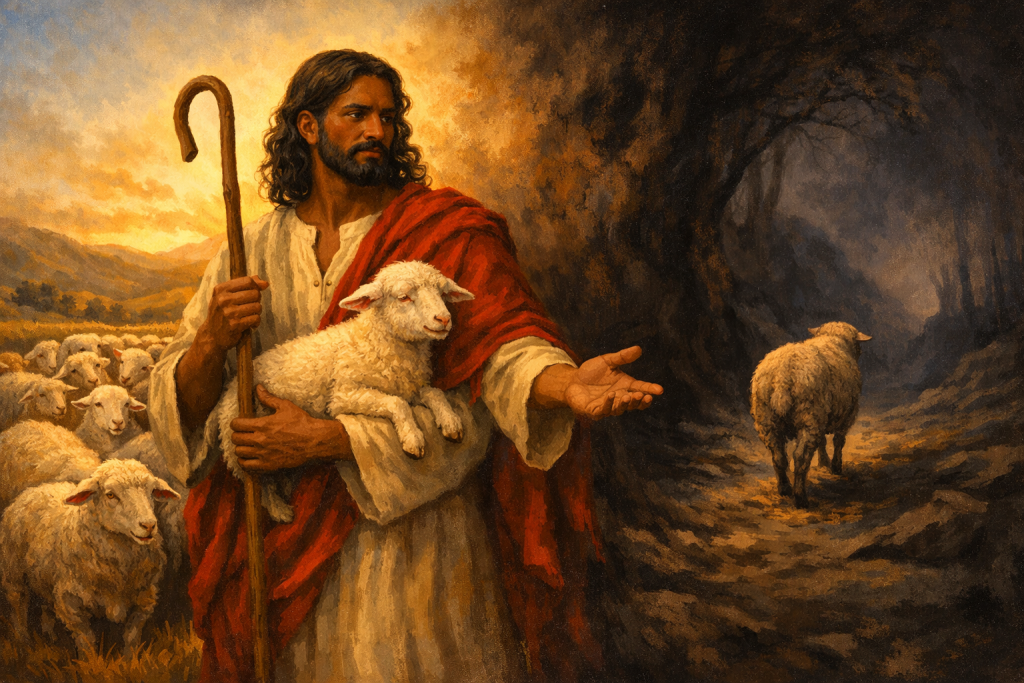
The recipients of the eternal life of verse 28 hear the shepherd’s voice and follow him. Anyone remotely familiar with sheep herding should have no problem understanding this imagery. A sheep or goat cannot willingly wander away from the shepherd while believing it has eternal safety. It does not work like that. Apart from the shepherd, no sheep is safe!
Lest anyone thinks this is a sheep analogy taken too far, John soon ensures that such confusion should not arise:
John 15:1-2, 4-6 ESV
[1] “I am the true vine, and my Father is the vinedresser. [2] Every branch in me that does not bear fruit he takes away, and every branch that does bear fruit he prunes, that it may bear more fruit.
[4] Abide in me, and I in you. As the branch cannot bear fruit by itself, unless it abides in the vine, neither can you, unless you abide in me. [5] I am the vine; you are the branches. Whoever abides in me and I in him, he it is that bears much fruit, for apart from me you can do nothing. [6] If anyone does not abide in me, he is thrown away like a branch and withers; and the branches are gathered, thrown into the fire, and burned.
It was an Agrarian age, and there was no limit to the life lessons that could be extracted from horticulture or animal rearing. The horticultural analogy makes the point better, since, unlike animals, plants do not wander. Jesus says his followers are like branches. Well, no branch of a plant survives apart from the plant rooted in the soil.
Additionally, the text also states a crucial point often forgotten in these conversations. The reason it is important to abide is so believers may bear fruit in this age:
John 15:8 ESV
By this my Father is glorified, that you bear much fruit and so prove to be my disciples.
Believers must abide in Jesus to be effective disciples in this age, and doing so glorifies the Father.
A Brief Refutation of OSAS from John 10:28 and the Life of Judas Iscariot
We have already argued that Paul and Peter reject OSAS. We also saw that 1 John 2 rejects OSAS. I now want to add the gospel of John to the list. I shall use the same passage above from John 10 to refute OSAS. For ease of reference, here is the passage again:
John 10:27-29 ESV
[27] My sheep hear my voice, and I know them, and they follow me. [28] I give them eternal life, and they will never perish, and no one will snatch them out of my hand. [29] My Father, who has given them to me, is greater than all, and no one is able to snatch them out of the Father’s hand.
The argument I want to present concerns Judas Iscariot. In John’s narrative world, 10:28 applies to Judas Iscariot as well. At this time, Judas was a qualifying sheep. He had heard Jesus’s voice through listening to Jesus’s teaching for about three years and followed him. When things got very hard, and many students deserted Jesus, Judas was one of those who remained (John 6:66-71). Let me address a famous problematic verse in this passage then:
John 6:70-71 ESV
[70] Jesus answered them, “Did I not choose you, the twelve? And yet one of you is a devil.” [71] He spoke of Judas the son of Simon Iscariot, for he, one of the twelve, was going to betray him.
Jesus says he chose Judas, as he did the other eleven; so, Jesus knew Judas. But he also says Judas is a devil – an accuser or a betrayer. Historically, people leaning towards the OSAS side of the debate have latched onto this verse to argue that Judas was not a genuine believer. But this is circular reasoning.
At the time of the event, John and everyone else did not even know who Jesus was talking about. It was only with the benefit of hindsight that John could write 6:71. Jesus chose Judas, just as he did everyone else. In fact, John does not begin to point out Judas’s shortcomings – and all the disciples had their infractions – in his account until 12:4-6. This is after John 10:28.
As I have argued elsewhere, the popular notion that Judas was never a true disciple of Jesus and was brought in only to betray Jesus does not paint Jesus in a good light. If, in betraying Jesus, Judas did what he could not help doing because of divinely sanctioned fate, that risks making the Father and Jesus monsters, and Judas as their victim. But if we set aside that theory-laden reading and read John on its own narrative merit, we see that there are no reasons to suppose that Judas was not as legitimate as the others at this point in the narrative development. If the reasoning above is correct, then John 10:28 applies to Judas Iscariot. He has shown himself to be Jesus’ sheep – and hence qualifies for the eternal life that Jesus grants his sheep.
Now, if all that is right, we can see a narrative-supported interpretation of John 10:28 – 29:
John 10:28-29 ESV
[28] I give them eternal life, and they will never perish, and no one will snatch them out of my hand. [29] My Father, who has given them to me, is greater than all, and no one is able to snatch them out of the Father’s hand.
When John reports that Jesus says, “No one will snatch them out of my hand” and “no one is able to snatch them out of the Father’s hand,” this would be a promise against external threats. Individuals can withdraw in defection. There is freedom within the Father’s hand. This seems to be the point John 17:12 also makes,
John 17:12 ESV
While I was with them, I kept them in your name, which you have given me. I have guarded them, and not one of them has been lost except the son of destruction, that the Scripture might be fulfilled.
Three additional points should be made here. First, all sides seem to agree that “lost” here is soteriological, not merely referring to physical death. Second, John 17:12 would contradict John 10:28-29 if we deny individual freedom to leave, and God would clearly have failed to protect everyone in his care. Judas could only be lost because God and Jesus failed to protect him. Third, I have argued elsewhere that we need not read the “that the Scripture might be fulfilled” language in a deterministic way. There are other philosophically valid and theologically sensitive ways to read it.
What this shows, then, is that Apostle John does not affirm OSAS. Jesus explicitly chooses Judas, included among the Twelve, entrusted with ministry, present for Jesus’s teaching, and kept by him until the moment of betrayal. Calling Judas “a devil” is a moral prediction, not a denial of his discipleship. John portrays Judas as a real sheep who later defected. This means John has no difficulty with the idea that someone may forfeit the life promised in Christ after genuinely participating in it. Judas is John’s Gospel’s own counterexample to the OSAS reading of John 10:28.
Final Thoughts
Let me rephrase where I stand. I wholeheartedly affirm OSAS, but with a slight modification: the believer must continue to abide in Jesus. And, no, this does not constitute working for salvation – after all, Jesus himself commands that believers abide in him. In any case, only a saved person can abide in Jesus. But a saved person can also choose not to abide. We are held by grace but also free to leave. Below are some final thoughts:
1. If you hold on to OSAS because that puts God in a beautiful light, helping you trust in the faithfulness of God that he will never forsake you, then go ahead. This is true so long as you continue to abide, however imperfectly, in Christ.
2. Non-OSAS believers like me do not claim that Jesus will forsake a believer because of every sin. Sins are not made equal. The only sin that will result in a forfeiture of salvation is the one that denies Jesus and his redemptive work.
3. We live in a depraved world, and we all daily struggle with sins of various weights. We do not celebrate the sins. Instead, we keep holding on to the Spirit to strengthen and help us become victorious over them. We are not orphans left to figure it all out on our own. The Spirit is given to work with us, but we have a real role to play, too.
Grace to the body.