This piece is written to address possible questions readers may have from reading the entry arguing that heaven is not the goal of the Christian life.
In this entry, I want to address well-known passages from 2 Corinthians concerning Paul’s vision and Jesus’s words to the thief on the cross. As we shall see, both Paul’s vision and Jesus’ promise rely on Second‑Temple Jewish categories that modern readers often flatten or misread. These passages, often isolated from their Jewish context, actually speak a common language about divine authority and the geography of the unseen realm. We begin with Paul:
2 Corinthians 12:1–3 (ESV)
[1] I must go on boasting. Though there is nothing to be gained by it, I will go on to visions and revelations of the Lord. [2] I know a man in Christ who fourteen years ago was caught up to the third heaven—whether in the body or out of the body I do not know, God knows. [3] And I know that this man was caught up into paradise—whether in the body or out of the body I do not know, God knows—
This is one of three places “paradise” occurs in the New Testament. The serious Bible student might recall that part of the Corinthian problem Paul faced was that he was being compared to some “super-apostles.” In effect, the church questioned some of the things Paul taught them. So, Paul had to demonstrate in different ways that the things he taught the church are legitimate and divinely sanctioned. To do that, Paul arguably pulled a big card from the Hebrew Bible.
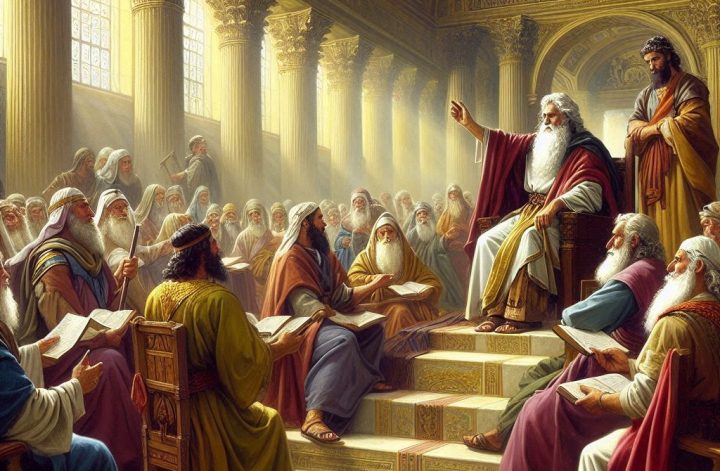
In the Old Testament, the only Bible used by all early believers and Jesus, there are two major ways to tell whether someone is a true prophet who genuinely hears from God. The first is obvious: if what you claimed you received from God came to pass, you very likely heard from God. This is especially so if what you prophesied was non‑obvious, complicated, or otherwise unusual. Of course, if what you asserted did not materialize, you were not a prophet. No do‑overs. Neither could there be do‑overs because the one you claimed to hear from is omniscient. He could not be wrong. The second way is different in that it is not verifiable, but it is weighty. True prophets often participated in the divine council. Isaiah saw the LORD and other members of the council (Isaiah 6). God himself directly speaks to this point in Jeremiah:
Jeremiah 23:17–18 (ESV)
[17] They say continually to those who despise the word of the Lord, “It shall be well with you”; and to everyone who stubbornly follows his own heart, they say, “No disaster shall come upon you.” [18] For who among them has stood in the council of the Lord to see and to hear his word, or who has paid attention to his word and listened?
The point is that those lying prophets did not hear from God because they did not stand in the divine council. If they did, they would have known what was decreed.
If Paul alludes to this criterion of discerning a true messenger of God in 2 Corinthians 12, he would have conveyed that his teachings are divinely authorized and, hence, trustworthy. His claims will eventually come to pass. This is the same literary point John conveys in Revelation when he says he was summoned to “come up here” (4:1). Participating in a divine council meeting is a standard scriptural way of communicating that one heard from God.
This brings me back to the question of paradise. Paul uses the term to signal his participation in the divine council. However, its use in Luke is different:
Luke 23:43 (ESV)
And he said to him, “Truly, I say to you, today you will be with me in paradise.”
These are the famous words of Jesus to the thief on the cross. “Paradise” here cannot mean heaven, as it is usually assumed. Jesus did not go to heaven on the day he was crucified. As I mentioned elsewhere, Jesus went to Hades on that day. Peter proclaims:
Acts 2:31 (ESV)
He foresaw and spoke about the resurrection of Christ, that he was not abandoned to Hades, nor did his flesh see corruption.
So, Jesus went to Hades—the realm of the dead—on the day of the crucifixion, from whence he was also resurrected. Also, in a famous post‑resurrection passage, when Mary saw the risen Jesus, he told her he was not yet returning to heaven (John 20:17). Indeed, his return to heaven was public in the ascension (Acts 1:9-10). So, whatever paradise means in Luke 23:43 is most likely a location in Hades.
Indeed, Second‑Temple era Jews believed there were two compartments in Hades. Everyone who dies goes to Hades, but the righteous and the unrighteous have separate areas. Luke preserves this notion in the Abraham’s‑bosom story:
Luke 16:22–23, 25–26 (ESV)
[22] The poor man died and was carried by the angels to Abraham’s side. The rich man also died and was buried, [23] and in Hades, being in torment, he lifted his eyes and saw Abraham far off and Lazarus at his side.
[25] But Abraham said, “Child, remember that you in your lifetime received your good things, and Lazarus in like manner bad things; but now he is comforted here, and you are in anguish. [26] And besides all this, between us and you a great chasm has been fixed, in order that those who would pass from here to you may not be able, and none may cross from there to us.”
Abraham, at the time of writing this passage, had long been dead. Since the resurrection has not happened yet, Abraham remains in the realm of the dead, Hades. So, Abraham, Lazarus, and the rich man are all in Hades, but not in the same compartment. Even in Hades, there is comfort for the righteous. This side of Hades is likely what paradise refers to in Luke 23:43.
So, though Paul equated “paradise” with “the third heaven” in describing a visionary experience – and this is important, rather than a literal journey – Luke’s use of the term is markedly different.
John’s use of the term in Revelation offers a third distinct way the New Testament employs it. For John, paradise refers to the restored earthly Eden:
Revelation 2:7 (ESV)
He who has an ear, let him hear what the Spirit says to the churches. To the one who conquers I will grant to eat of the tree of life, which is in the paradise of God.
Etymologically, paradise is actually a borrowed Persian term meaning “walled garden.” So, John’s use is closer to the original meaning of the word, but none of the three New Testament uses requires it to refer to heaven in the usual sense. As I explained elsewhere, the New Jerusalem is an earthly city with a heavenly origin:
Revelation 21:1-2; 22:2 NRSVUE
[1] Then I saw a new heaven and a new earth, for the first heaven and the first earth had passed away, and the sea was no more. [2] And I saw the holy city, the new Jerusalem, coming down out of heaven from God, prepared as a bride adorned for her husband.
[22:2] through the middle of the street of the city. On either side of the river is the tree of life with its twelve kinds of fruit, producing its fruit each month, and the leaves of the tree are for the healing of the nations.
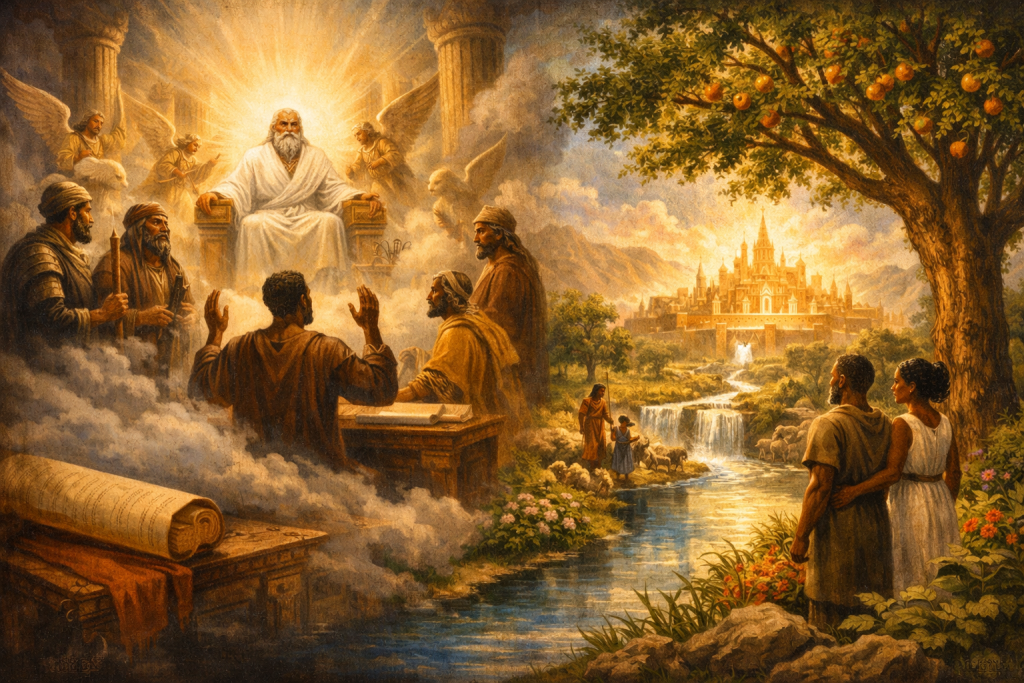
The city comes down from heaven. It has a heavenly origin but is destined for Earth. So, the restored earthly Eden is the paradise of God in Revelation.
Once we recover the Jewish ideas behind these texts, Paul’s vision, Jesus’ promise, and John’s revelation stop sounding contradictory and instead reveal a single story. Paradise, the divine council, Hades, and the restored Eden are not competing ideas but pieces of the same biblical worldview—one in which God’s presence, judgment, and restoration move through heaven, earth, and the realm of the dead until creation is finally renewed.