
The Commissioner went away, taking three or four of the soldiers with him. In the many years in which he had toiled to bring civilization to different parts of Africa he had learnt a number of things. One of them was that a District Commissioner must never attend to such undignified details as cutting down a dead man from the tree. Such would give the natives a poor opinion of him. In the book which he planned to write he would stress that point. As he walked back to the court he thought about that book. Every day brought him some new material. . . . There was so much else to include, and one must be firm in cutting out details (147-48).
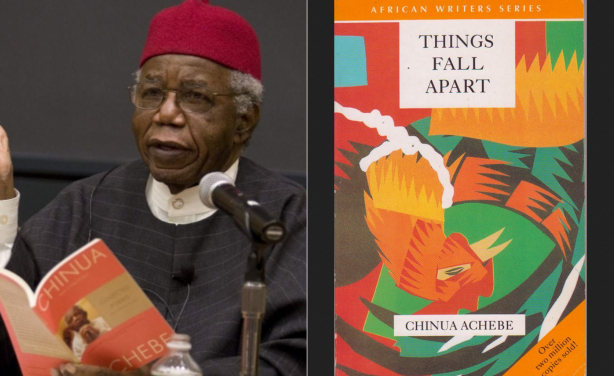
The passage above comes from the last paragraph of Chinua Achebe’s most-read work, Things Fall Apart. It contains one of the many brilliant arguments marshaled in this world-renowned book that has generated the highest number of critics and critiques. With that deft and pithy stroke, Achebe reveals the sheer arrogance of the colonial enterprise masquerading as leadership as well as argues that the hitherto largely unchallenged representation of Africans by European writers is spurious. By admitting that “There was so much else to include . . . [but] one must be firm in cutting out details,” the Commissioner—who is an exemplar of European imperialism—shows that his prospective The Pacification of the Primitive Tribes of the Lower Niger is unreliable and biased. The palpable overarching argument Achebe makes is that all Europeans who have ever written about Africa, whether in fictionalized or historical forms, are false authorities whose works should not be trusted.
The Commissioner’s choice of words is also worth noting. He speaks of “the many years in which he had toiled to bring civilization to different parts of Africa” as though it were an obligation or duty. Indeed, it is worse than that. As Ipshita Chanda points out in “Hawk and Eagle: Cultural Encounters and the Philosophy of ‘Understanding’ in Achebe’s Narratives,” it is more of an obsession. She recalls how one of the champions of the Enlightenment, the ideological movement that founded the enterprise of colonialism on a strong philosophical and moral basis, had pictured a Utopia that the Enlightenment was sure to deliver; for Immanuel Kant, to think of the Enlightenment phenomenon as a mere European happening was ridiculous. Enlightenment was a universal or, even more correctly, “human” phenomenon: