
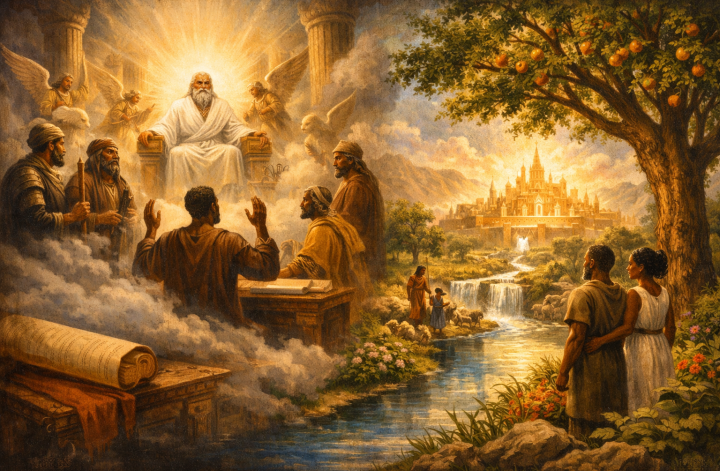
This piece is written to address possible questions readers may have from reading the entry arguing that heaven is not the goal of the Christian life.
In this entry, I want to address well-known passages from 2 Corinthians concerning Paul’s vision and Jesus’s words to the thief on the cross. As we shall see, both Paul’s vision and Jesus’ promise rely on Second‑Temple Jewish categories that modern readers often flatten or misread. These passages, often isolated from their Jewish context, actually speak a common language about divine authority and the geography of the unseen realm. We begin with Paul:
2 Corinthians 12:1–3 (ESV)
[1] I must go on boasting. Though there is nothing to be gained by it, I will go on to visions and revelations of the Lord. [2] I know a man in Christ who fourteen years ago was caught up to the third heaven—whether in the body or out of the body I do not know, God knows. [3] And I know that this man was caught up into paradise—whether in the body or out of the body I do not know, God knows—
This is one of three places “paradise” occurs in the New Testament. The serious Bible student might recall that part of the Corinthian problem Paul faced was that he was being compared to some “super-apostles.” In effect, the church questioned some of the things Paul taught them. So, Paul had to demonstrate in different ways that the things he taught the church are legitimate and divinely sanctioned. To do that, Paul arguably pulled a big card from the Hebrew Bible.
In the Old Testament, the only Bible used by all early believers and Jesus, there are two major ways to tell whether someone is a true prophet who genuinely hears from God. The first is obvious: if what you claimed you received from God came to pass, you very likely heard from God. This is especially so if what you prophesied was non‑obvious, complicated, or otherwise unusual. Of course, if what you asserted did not materialize, you were not a prophet. No do‑overs. Neither could there be do‑overs because the one you claimed to hear from is omniscient. He could not be wrong. The second way is different in that it is not verifiable, but it is weighty. True prophets often participated in the divine council. Isaiah saw the LORD and other members of the council (Isaiah 6). God himself directly speaks to this point in Jeremiah: