The Commissioner went away, taking three or four of the soldiers with him. In the many years in which he had toiled to bring civilization to different parts of Africa he had learnt a number of things. One of them was that a District Commissioner must never attend to such undignified details as cutting down a dead man from the tree. Such would give the natives a poor opinion of him. In the book which he planned to write he would stress that point. As he walked back to the court he thought about that book. Every day brought him some new material. . . . There was so much else to include, and one must be firm in cutting out details (147-48).
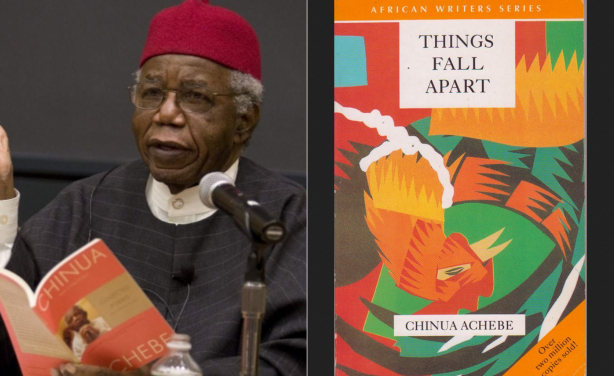
The passage above comes from the last paragraph of Chinua Achebe’s most-read work, Things Fall Apart. It contains one of the many brilliant arguments marshaled in this world-renowned book that has generated the highest number of critics and critiques. With that deft and pithy stroke, Achebe reveals the sheer arrogance of the colonial enterprise masquerading as leadership as well as argues that the hitherto largely unchallenged representation of Africans by European writers is spurious. By admitting that “There was so much else to include . . . [but] one must be firm in cutting out details,” the Commissioner—who is an exemplar of European imperialism—shows that his prospective The Pacification of the Primitive Tribes of the Lower Niger is unreliable and biased. The palpable overarching argument Achebe makes is that all Europeans who have ever written about Africa, whether in fictionalized or historical forms, are false authorities whose works should not be trusted.
The Commissioner’s choice of words is also worth noting. He speaks of “the many years in which he had toiled to bring civilization to different parts of Africa” as though it were an obligation or duty. Indeed, it is worse than that. As Ipshita Chanda points out in “Hawk and Eagle: Cultural Encounters and the Philosophy of ‘Understanding’ in Achebe’s Narratives,” it is more of an obsession. She recalls how one of the champions of the Enlightenment, the ideological movement that founded the enterprise of colonialism on a strong philosophical and moral basis, had pictured a Utopia that the Enlightenment was sure to deliver; for Immanuel Kant, to think of the Enlightenment phenomenon as a mere European happening was ridiculous. Enlightenment was a universal or, even more correctly, “human” phenomenon:
Enlightenment is man’s emergence from his self-incurred immaturity. Immaturity is the inability to use one’s own understanding without the guidance of another. . . .[L]aziness and cowardice are the reasons why such a large population of men, even when nature has long emancipated them from alien guidance, nevertheless so gladly remain immature (103-104).
It is no surprise, then, that the District Commissioner wears a similar attitude, for he is a conveyer of this Enlightenment good news to the distant, dark world of Africa. Laura Kunreuther traces the strong connection between the Enlightenment and colonialism. Quoting Nicholas Dirk, an anthropologist, she writes:
“Colonialism provided a theatre for the Enlightenment project,” writes Dirk. “Science flourished in the eighteenth century not merely because of the intense curiosity of individuals working in Europe, but because colonial expansion both necessitated and facilitated the active exercise of the scientific imagination. . . . Even history and literature could claim vital colonial connections, for it was through the study and narrativization of colonial others that Europe’s history and culture could be celebrated as unique and triumphant (77).
Things Fall Apart has won Achebe worldwide recognition, and he has been called the inventor of modern postcolonial literature. Simon Gikandi writes of him: “Achebe is the man who invented African literature because he was able to show, in the structure and language of [Things Fall Apart], that the future of African writing did not lie in simple imitation of European forms but in the fusion of such forms with oral traditions” (xvii). Recognizing that Things Fall Apart is “an exercise in historical recuperation,” Richard Begam writes in “Achebe’s Sense of an Ending: History and Tragedy in Things Fall Apart”:
Achebe writes a form of nationalist history. Here the interest is essentially reconstructive and centers on recovering an [African] past that has been neglected or suppressed by historians who would not or could not write from an African perspective. . . . Nationalist history tends to emphasize what other histories have either glossed over or flatly denied.
Throughout the pages of Things Fall Apart, Achebe alludes to the inaccuracy of African representation by European authors and stresses that, as Begam quotes, “African people did not hear of culture for the first time from Europeans; that their societies were not mindless but frequently had a philosophy of great depth and value and beauty, that they had poetry and, above all, they had dignity” (397).
As many critics have also noted, Achebe rewrites African history “without romanticizing the African past” (Gikandi, xii). Indeed, in Things Fall Apart, Achebe portrays the protagonist, Okonkwo, as an overwhelmingly flawed character. Even though he is a hero and a “proud and imperious emissary of war” who is “treated with great honour and respect” (09) by his people, he is not infallible; often, his errors have grave consequences. Indeed, Okonkwo’s divergent views on family relationships, leadership, and colonialism counter traditional Igbo mores and precipitate the ultimate disintegration of the tribal Igbo community in the face of British imperialism.
Okonkwo Has a Faulty View of Traditional Family Relationships
The tribal Igbo community of Okonkwo has its mores that every child learns as it grows up. A man is the head of his family meaning that he is the primary provider. The people’s staple food is yam, and “Yam, the king of crops, was a man’s crop” (16) because it requires a lot of muscular work over a relatively long period to grow it. When the harvest comes, the man feeds his family primarily from the produce; it was a subsistent kind of farming. As Achebe emphatically reiterates, “Yam stood for manliness, and he who could feed his family on yams from one harvest to another was a very great man indeed” (24). Often the woman helps the man by growing “women’s crops, like coco-yams, beans and cassava” (16) alongside with him. It is, however, the woman who typically runs the house since the man often spends most of the hours on the farm. Achebe writes, for instance, about Okonkwo that “During the planting season Okonkwo worked daily on his farms from cock-crow until the chickens went to roost” (10). She ensures that the family meals are prepared in time, teaches the kids family values, make sure the house constantly have enough water to run on, and represents the man in absentia. Above all, the woman respectfully and lovingly submits to the man as the head of the house.
Having a distorted view of what it means to be a man and father, and this being engendered by his childhood experience, “Okonkwo [rules] his household with a heavy hand” (09). His father, Unoka, becomes a pariah towards the end of his life partly because he is struck by a disease but also because he was an agbala. All these happenings make the puerile mind of Okonkwo wrongly associate his father’s shortcomings with that of fatherhood. Unoka becomes the exact antithesis of Okonkwo’s life “[and] so Okonkwo was ruled by one passion—to hate everything that his father Unoka had loved” (10). Thus, whereas Unoka is a gentle, cheerful being who loves his people and family, Okonkwo beats his own family and would not vacillate to “pounce on people” (03) when the opportunity presents itself. So deep in his mind is this misconception that Okonkwo would not “stop beating somebody half-way through, not even for fear of a goddess” (21). Such is the act that makes him break the sanctity of the Week of Peace when he pounces on his wife for not cooking his food in time—an act for which he duly pays. It is worth noting that Okonkwo, who apparently lacks self-control, could have cut short his life by this sacrilegious act because, as Ogbuefi Ezeudu points out, the penalty for such a thing used to be fatal: “My father told me that he had been told that in the past a man who broke the peace was dragged on the ground through the village until he died” (23). Nwoye is the other unfortunate recipient of Okonkwo’s raw fury. At the sight of what he sees to be “incipient laziness” (10) and “[too] much of his grandfather” (46), Okonkwo tries to nurture Nwoye into a man of his own image—through incessant nagging and beating. Indeed, it seems like he is going to achieve that goal until he takes away Nwoye’s adopted brother. The last straw that breaks the camel’s back is the event that takes place after Nwoye’s affiliation with the Christians is discovered:
Nwoye turned round to walk into the inner compound when his father, suddenly overcome with fury, sprang to his feet and gripped him by the neck.
‘Where have you been?’ he stammered.
Nwoye struggled to free himself from the choking grip.
‘Answer me,’ roared Okonkwo, ‘before I kill you!’
He seized a heavy stick that lay on the dwarf wall and hit two or three savage blows.
Had Okonkwo not killed Ikemefuna, he ostensibly would not have had to lose his firstborn child because “[Ikemefuna] was like an elder brother to Nwoye, and from the very first [encounter] seemed to have kindled a new life in the younger boy.” Nwoye is developing into the very chap that his father has always wanted him to become. The boy was letting go of some of his “grandfather” within him. He “no longer spent the evenings in [his] mother’s hut while she cooked, but now sat with Okonkwo in his obi, or watched him as he tapped his palm tree for the evening wine” (37). When Okonkwo kills Ikemefuna, however, he unknowingly gives Nwoye another reason to become a dissident, first, at heart. It is, thus, Okonkwo’s distorted view of how a family should be run that ruined him first; his views run counter to those of the majority of his constituents.
It is unbecoming enough that Okonkwo does not have a popular understanding of how to be the head of a family; it is worse that, though he is “one of the greatest men of his time,” he also does not have a good grasp of what leadership—as understood by his society—is all about. It is true that among his people, “achievement [is] revered” (06), but there is another side to the coin of leadership as conceived of by the tribal Igbo community; a leader is rational and analytical. Obierika is perhaps the best character that illustrates this leadership quality. After Okonkwo had killed Ikemefuna, he went to visit Obierika, wondering why his friend did not come along to do the bidding of the Oracle:
‘I cannot understand why you refused to come along with us to kill that boy,’ he asked Obierika.
‘Because I did not want to,’ Obierika replied sharply. ‘I had something better to do.’
It is worth noting that whereas Okonkwo’s understanding of leadership is one necessarily subservient to the gods, Obierika’s is one where he retains his will and reasoning regardless of what the gods say. Obierika even dares to say that he “had something better to do” than do the will of a god. Okonkwo then momentarily forgets that the man he is talking to is an achiever like himself, which was why they became friends in the first place—since Okonkwo “[has] no patience with unsuccessful men”(03)—and wrongly concludes that Obierika is a coward:
‘But someone had to do it. If we were all afraid of blood, it would not be done. And what do you think the Oracle would do then?’
Obierika has to remind him: “You know very well, Okonkwo, that I am not afraid of blood; and if anyone tells you that I am, he is telling a lie” (46).
Apparently, these two leaders do not have the same understanding. Obierika is more analytical and sound in his judgment. As he pointedly argues, “if the Oracle said that my son should be killed I would neither dispute it nor be the one to do it” (47).
Okonkwo has a faulty view of traditional leadership
Okonkwo’s view of leadership is simply deficient. Not only is he very prone to irrational behaviour, but he also does irrational things because of his view on gender roles. Driven by fear of being seen as weak and a failure, like Unoka, Okonkwo deifies masculinity. His primary motivation, “to hate everything that his father Unoka had loved,” includes hating “gentleness.” He thinks gentleness is a feminine or agbala trait. As mentioned en passant earlier, it is this extreme view on masculinity that encouraged him to kill his adopted son. This is also the reason he thinks his closest friend is a coward. Besides, Okonkwo is also psychologically unstable. As Polycarp Ikuenobe, an Igbo critic, points out, “In order to achieve [leadership], an individual must be ‘psychologically wholesome,’ emotionally and rationally stable, communally well adjusted, and must consistently show excellent judgment” (125). If this “Ikuenobian” requirement were a sacrosanct litmus test for leadership, Okonkwo would be nowhere close to passing it. Okonkwo has an emotional instability syndrome; in fact, it seems like his overall phenotype bears witness to this condition. Achebe writes about Okonkwo:
He was tall and huge, and his bushy eyebrows and wide nose gave him a very severe look. He breathed heavily, and it was said that, when he slept, his wives and children in their out-houses could hear him breathe. When he walked, his heels hardly touched the ground and he seemed to walk on springs as if he was going to pounce on somebody. And he did pounce on people quite often. He had a slight stammer and whenever he was angry and could not get his words out quickly enough, he would use his fists (03).
About the only Ikuenobian quality one could say that Okonkwo possesses, arguably, would be being “communally well adjusted.” He is so fearsome that “His wives, especially the youngest, lived in perpetual fear of his fiery temper, and so did his little children” (09). Summarizing Okonkwo’s divergent and deficient view on leadership, Chanda notes:
Okonkwo laboured under the delusion that his society expected him to exhibit a rigid masculinity. It was, in fact, not his society that exacted this self-definition from him but his own personal history. Okonkwo’s mistake, pointed out to him again and again by his peers and by elders, was to hierarchize genders, privileging the masculine over the feminine, valorizing the former and belittling the latter.
Achebe portrays Okonkwo as having a divergent view on colonialism
Many critics, especially non-African ones, readily note that Things Fall Apart is “an exercise in historical recuperation.” Carey Snyder, for instance, concurs that “.[Things Fall Apart] aims to wrest from the colonial metropole control over the representation of African lives, staking a claim to the right to self-representation” (155). A striking observation, however, is the somewhat unanimous proclivity of these critics not to challenge the accuracy of Achebe’s representation of Africa. The history of Nigeria supports the depiction of colonialism in Things Fall Apart. As Don C. Ohadike notes, “European slave traders had exported substantial numbers of Igbo people from the Bight of Biafra to the New World. Nonetheless, no European had penetrated the interior of Igboland before 1830” (xxxix). It should be recalled that the United Kingdom touched off abolition of slavery politics when the nation realized “that the slave trade was no longer consistent with [her] economic interests,” (xxxix) in the 1830’s and that America followed suit in the 1860’s. A passage in Things Fall Apart supports this view. After the clan of Abame has been wiped out, Obierika, while retelling the story to Okonkwo who is on exile, says “We have heard stories about white men who made the powerful guns and the strong drinks and took slaves away across the seas, but no one thought the stories were true” (99). The people did not believe the account because they had never seen a white man before. That the people never saw a white man supports the view that no white man had ever “penetrated the interior of Igboland.” Ohadike continues, “While the abolition debate raged on, however, certain interest groups in Europe and America formed societies to push European cultural, commercial, and political influence into African interior” (xxxix)—thus was born the genesis of the exodus of Europeans into the interior of tribal Igbo community.
Christian missionaries played a very huge role in the invasion of Igbo land, argues Ohadike. They were the first Europeans to gain access into the core of Igbo society in fairly large numbers. As they trooped inwards, they took along their foreign ideals that ultimately clashed with the people’s mores. Their reports of the African ways of life to their home governments spurred European imperialism, continues Ohadike (xli). This is the picture depicted on the latter pages of Things Fall Apart, and these inaccurate reports were what European writers heavily relied on in writing about Africa. An interesting historical fact that Ohadike mentions is “that many of the most effective [Christian] missionaries were, in fact, Africans” that were either born to former slaves or are ex-slaves. Achebe alludes to this when he writes that an interpreter of the white man is an Ibo man and that three other members of the white man’s company speak Ibo (102).
The tribal society’s general disposition towards the colonial officials is ambivalent. Though the white man “put[s] a knife on the things that held” (125) the people together, but he also helps to improve the economy of the land by his trading with the people such that “for the first time palm-oil and kernel became things of great price, and much money flowed into Umuofia” (126). This realization and the soft-treading, mutually respectful style of Christianity that Mr Brown practices ministers to the soul of the “many men and women in Umuofia who [do] not feel as strongly as Okonkwo about the new dispensation” (126). So potent is this happening that even a high-ranking title-holder, Ogbuefi Ugonna, “like a madman had cut the anklet of his titles and cast it away to join the Christians” (123). Even the unyielding and unconvinced Akunna, who never stops having protracted ontological and epistemological discourse with Mr. brown, releases one of his sons to attend the Christian school. He seems struck by “something vaguely akin to method in the overwhelming madness” (126) that has visited the community. The white man’s religion seems to make sense. “From the very beginning,” Mr Brown ensures that “religion and education [go] hand in hand” (128). Nevertheless, a number of people including Obierika do not feel good about this development.
While there are a significant number of people who do not feel positive about the deeds of the white man, no one suggests violence. The thoughtful Obierika thinks such an act will not be wise: “It is already too late. Our own men and our sons have joined the ranks of the stranger. They have joined his religion and they help to uphold his government” (124). Being his typical self, Okonkwo calls for immediate war to cleanse the land. He boasts of how Umuofia is immeasurably greater than the clan that the white man has wiped out: “We would be cowards to compare ourselves with the men of Abame.
Their fathers had never dared to stand before our ancestors. We must fight these men and drive them from the land” (124). When he cannot convince the people to go to war, “he [mourns] for the warlike men of Umuofia who [have] so unaccountably become soft like women” (129). Of course, Okonkwo remains a man; he could not be agbala—and he proves that when the opportunity presents itself. Being already “choked with hate,” (138) Okonkwo is now “trembling with hate” at the sight of some messengers who have come to stop the meeting of the elders of Umuofia. When he cannot withstand it all any longer, “In a flash Okonkwo drew his matchet. The messenger crouched to avoid the blow. It was useless. Okonkwo’s matchet descended twice and the man’s head lay beside his uniformed body” (144). Realizing that even this typically “manly” act would not spur Umuofia to action, Okonkwo concludes that his people have indeed become agbala; it is hopeless. Thus, “[he] wiped his matchet on the sand and went away” (145) to end it all. Begam captures the symbolism of that act when he writes that “the people of Umuofia have deserted Okonkwo and in the process betrayed themselves, but the wiping of the machete is the only eloquence he permits himself.” Okonkwo “symbolically dissolves his connection with his people,” continues Begam, “wiping away the blood bond that has joined them” (400). Begam adds: “In taking his own life, Okonkwo has simply preceded his people in their communal destruction” (401). Hence, Okonkwo’s extreme and violent response to the morass of colonial rule precipitates the dissolution of his society.
As flawed as he is, Okonkwo remains a hero—“we must recognize that Okonkwo’s faults are essentially virtues carried to an extreme and that while he is obviously not perfect, he nevertheless represents some of the best qualities of his culture,” (400) warns Begam. Indeed, Achebe’s portrayal of his hero as an imperfect person amazes critics who know of the author’s intention to rewrite the history of Africa. For some critics, this is one of the novel’s strengths, making it suitable as a critique of the Enlightenment in first-year-level anthropology and philosophy classes around the world. Commenting on Achebe’s way of ending the novel, especially the last paragraph, Kunreuther (72) writes:
Ending this way, Achebe draws attention to his own writing and how it may be different than the Commissioner’s prospective book. In doing so, he invokes the position of the reader. Readers are called upon to critically reflect upon what they have just read, to interrogate the novel in relation to this other prospective book, and to read the novel not as a typical tale of Igbo society but, rather, as an engagement with the complexities of diverse psychological characters and the subtle transformation in daily life and cultural beliefs and values before and during the beginning days of colonial contact. Achebe, after saying so much, is, in essence, saying to the readers, in the words of Uchendu to Okonkwo, “I have no more to say to you” (95).
Works Cited
Achebe, Chinua. Things Fall Apart. Exp. ed. with notes. Oxford: Heinemann, 1996. Print. African Writers Series. Classics in Context.
Begam, Richard. “Achebe’s Sense of an Ending: History and Tragedy in Things Fall Apart.” Studies in the Novel 29.3 (1997): 396 – 411. MLA International Bibliography. Web. 17 Oct. 2012.
Chanda, Ipshita. “Hawk and Eagle: Cultural Encounters and the Philosophy of ‘Understanding’ in Achebe’s Narratives.” Philosophia Africana 9.2 (2006):101 – 16. MLA International Bibliography. Web. 17 Oct. 2012.
Gikandi, Simon. “Chinua Achebe and the Invention of African Literature.” Things Fall Apart. By Chinua Achebe. Exp. ed. with notes. Oxford: Heinemann, 1996. ix –xvii. Print. African Writers Series. Classics in Context.
Ikuenobe, Polycarp. “The Idea of Personhood in Chinua Achebe’s Things Fall Apart” Philosophia Africana 9.2 (2006): 117 – 31. MLA International Bibliography. Web. 22 Oct. 2012.
Kunreuther, Laura. “‘Pacification of the Primitive’: The Problem of Colonial Violence.” Philosophia Africana 9.2 (2006): 67-82. MLA International Bibliography. Web. 17 Oct. 2012.
Ohadike, Don C. “Igbo Culture and History.” Things Fall Apart. By Chinua Achebe. Exp. ed. with notes. Oxford: Heinemann, 1996. xix-xlix. Print. African Writers Series. Classics in Context.
Snyder, Carey. “The Possibilities and Pitfalls of Ethnographic Readings: Narrative Complexity in Things Fall Apart.” College Literature 35.2 (2008): 154 – 74. MLA International Bibliography. Web. 17 Oct. 2012.