
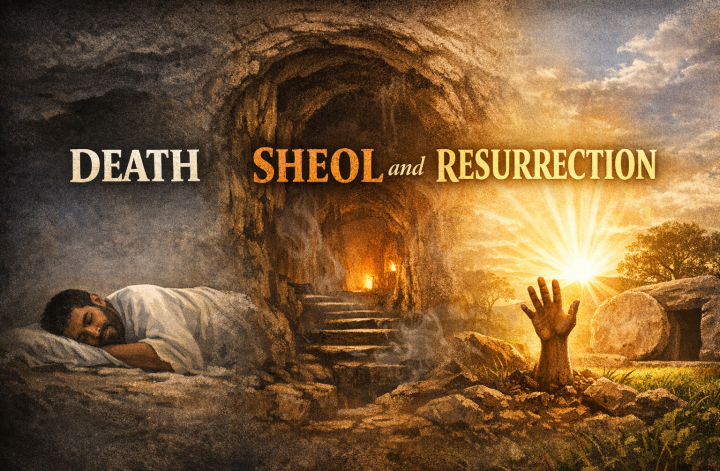
Death, Sheol, and Resurrection: What Happens When We Die?

This piece is adapted from a longer entry investigating Word of Faith theology.

Generations of believers have been taught that they will go to heaven when they die. People, of course, know they will not go to heaven as they are on earth. Everyone knows that the body decays in the grave when someone dies. Hence, one tradition says it is the spirit of the person that goes to heaven. So, life after death is quite spiritual. In this piece, I want to show that this common view is mistaken by exploring biblical data on life after death.

Let us begin with this: Do humans continue to exist when they die—that is, when the spirit separates from the body? This is a remarkably complex question that we cannot do justice to in this short entry. However, we will make a few key points. First, the answer is both Yes and No. When people die, they obviously cease to exist in the way they used to be. Indeed, death seems to be the precise word we use to describe the cessation of the life of a person as we knew it. Properly speaking, a human life is an embodied life. So, once the body ceases to be animated, life as we know it ceases. But it is also true that the ancients in the Bible thought that a dead person continues to exist:

Ecclesiastes 12:7 ESV
and the dust returns to the earth as it was, and the spirit returns to God who gave it.

This text, made famous by its frequent use at Services of Songs for the deceased, suggests a reversal of the creation of the human in Genesis: the breath of life returns to God, and the body dissolves into the earth. This may lead one to think the dead continue to exist with God in some spiritual form. But as we shall soon see, this existence consists of almost nothing. Some other texts suggest that the dead go to the realm of the dead, characterized by inactivity:

Ecclesiastes 9:10 ESV
Whatever your hand finds to do, do it with your might, for there is no work or thought or knowledge or wisdom in Sheol, to which you are going.

It seems that the two ideas above from Ecclesiastes say the same thing. When people die, they enter into a realm of inactivity. Yes, they continue to exist, but only in a state of deep sleep.

Furthermore, Christians have wondered if Paul’s words clarify the matter before us. For instance, Word of Faith brethren often take a few texts from Paul to support the view that the human spirit is the real person that endures after death:

Philippians 1:22-23 ESV
[22] If I am to live in the flesh, that means fruitful labor for me. Yet which I shall choose I cannot tell. [23] I am hard pressed between the two. My desire is to depart and be with Christ, for that is far better.

Very clearly, Paul is here talking about his imminent death. He says, “I am to live in the body,” implying that the “I” is distinct from the body. Indeed, the “I” lived in a body. This “I” is usually understood as referring to Paul’s spirit. Paul says the process of death would let him – or rather, the “I” part of him – “be with Christ, for that is far better.” However, whatever Paul means here cannot correspond to what is usually imagined. Paul is not here saying his spirit would be with Christ, able to pick heavenly apples or participate in a heavenly church service. Here is what Paul says elsewhere and in more detail about existence after death:

1 Thessalonians 4:13-14, 16-17 ESV
[13] But we do not want you to be uninformed, brothers, about those who are asleep, that you may not grieve as others do who have no hope. [14] For since we believe that Jesus died and rose again, even so, through Jesus, God will bring with him those who have fallen asleep.
[16] For the Lord himself will descend from heaven with a cry of command, with the voice of an archangel, and with the sound of the trumpet of God. And the dead in Christ will rise first. [17] Then we who are alive, who are left, will be caught up together with them in the clouds to meet the Lord in the air, and so we will always be with the Lord.

Paul says that “the Lord himself will descend from heaven.” First, notice that Jesus does not descend with an army of believers who had already gone to be with him. Second, the passage says “the dead in Christ will rise first.” The “dead in Christ” are, of course, believers who have died. The fact that they rose first on the last day implies they had not risen before then. In other words, just as Ecclesiastes says, the dead were in a state of inactivity. In short, they were dead. So, whenever Paul finally died and went to be with Christ, he would be among the dead rising first on the last day. In the meantime, he is sleeping in the Lord. No humans are walking the streets of heaven with Jesus now. Jesus is already resurrected, but believers are not. We hope and await our resurrection. Until then, all who have ever died in the Lord remain asleep.

We should briefly bring up two points from Revelation. But first, we should recall that Revelation is an apocalyptic writing that features a woman clothed with the sun, a red dragon sweeping down stars from heaven, among other notable apocalyptic elements. But even here, we do not read about the righteous dead attending a heavenly church service. Indeed, when Revelation references the righteous dead, they are not described as spirits but souls:

Revelation 6:9-11 ESV
[9] When he opened the fifth seal, I saw under the altar the souls of those who had been slain for the word of God and for the witness they had borne. [10] They cried out with a loud voice, “O Sovereign Lord, holy and true, how long before you will judge and avenge our blood on those who dwell on the earth?” [11] Then they were each given a white robe and told to rest a little longer, until the number of their fellow servants and their brothers should be complete, who were to be killed as they themselves had been.

If the Word of Faith theory is correct, that the spirits of the departed return to God as the real human entities, this text shows no awareness of that idea. Furthermore, notice that the souls were “told to rest a little longer.” Resting is basically what they had been doing. We should not press the apocalyptic language about the souls’ complaint or their being robed for literalness. What is clear from the whole book is that there is now no human walking about in heaven. We have argued elsewhere that the Twenty-four Elders, who continuously worship God, are unlikely to be human.

One more point is worth making. It is rather remarkable that on the last day, both the righteous and the unrighteous will be raised and re-embodied before being judged:

Acts 24:14-15 ESV
[14] But this I confess to you, that according to the Way, which they call a sect, I worship the God of our fathers, believing everything laid down by the Law and written in the Prophets, [15] having a hope in God, which these men themselves accept, that there will be a resurrection of both the just and the unjust.

Revelation 20:12-13 ESV
[12] And I saw the dead, great and small, standing before the throne, and books were opened. Then another book was opened, which is the book of life. And the dead were judged by what was written in the books, according to what they had done. [13] And the sea gave up the dead who were in it, Death and Hades gave up the dead who were in them, and they were judged, each one of them, according to what they had done.

Biblical resurrection is a bodily exercise. These texts say that even the unrighteous will be raised to be judged. But if the human spirit is the real person, why would God reconstitute the spirit plus the body before judgment? The unrighteous dead are not with Jesus. Presumably, they are in a bad place in Sheol. If so, why would God not leave them there but reconstitute them for judgment? The answer seems simple. Just as we have on page one of the Bible, humans are a composite whole. Hence, the whole person (body plus soul/spirit) – righteous and unrighteous – must face judgment “according to what they had done.” The being who “had done” something was a composite whole.

Also, it is worth mentioning that the righteous will not live a disembodied life in the age to come. On the contrary, they will be reclothed in glorified bodies. These new bodies will be the same bodies the righteous possess in the present age, but recreated and perfected. So, at no time in the entire span of life, covering the present and future ages, do humans live a disembodied life, except in Sheol. And existence in Sheol, as Ecclesiastes tells us, is no life at all. The real future life for humanity will be an embodied one on a recreated earth, not heaven. (See our entry on this subject here.)

Continue Reading