
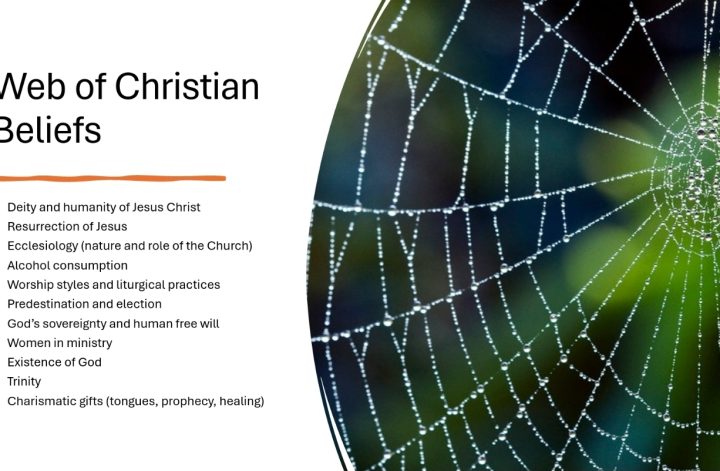
This is one of the introductory ideas I included in the curriculum I designed for a local church. I firmly believe that we ought to pay more attention to it.
I am no arachnologist, but it’s my understanding that the center of a spider web is functionally the most essential part of the structure. It’s critical for directing the structure’s geometry and for sensing vibrations. Every part of the web is important, but not equally so. As you travel radially outwards from the center, functional importance reduces. This is instructive by analogy: If we could empty people’s cherished beliefs into buckets – and every human has them – we would see that people do not exactly believe the same things in the same way.
Let’s take Christian beliefs, for example. Consider the list of Christian doctrines/beliefs in the attached image. If we were to arrange the most important and central beliefs at the center of a web and move outwards as the centrality of the beliefs decreases, different people would arrange them differently. (You can share how you would sort them in the comments and compare with others.)
I wager that almost everyone would agree on how to sort some of the items. For instance, every Christian would place belief in God’s existence at the center. There is at least one other entry on the list that I would place at the center: the resurrection of Jesus. Some of the other entries may not be at the center, but won’t be far removed in my sorting. But there also are some items that will be near the periphery.
In my assessment, too many Christians are raised to put everything at the center. For them, every belief is central and core to the faith. This includes such strange and colonial ideas as the King James Version being the only (or the most) inspired translation, an idea no Christian in the first century would have thought of. This way of doing things makes the faith much more challenging to believe and work out. It also seems like an excellent way to make people abandon the faith.
There are two relevant instructive examples from Paul’s ministry. The Roman church once debated the appropriateness of eating meat. Perhaps this resulted from the ubiquitous fact that meat sold at the market was typically sacrificed to other gods/idols. Whatever the case, Paul settled the debate by recognizing that this was a disputable matter and that there was more than one valid way to go. So, he allowed each one to do according to his conscience, even though he personally believed it was okay to eat meat (Romans 14:1-7). What was most important was to do everything in love – and in this context, love looked like forsaking that juicy steak if doing so would burden another’s mind and conscience.
But when the Corinthians began to malfunction and deny the resurrection, there was no time for compromise. Paul told the Corinthians they could not even be Christians if the resurrection was false. The death of Jesus, per se, does not atone. It is the death of Jesus AND the resurrection (AND the Ascension, according to the book of Hebrews) that afford human salvation.
What we see at play is the importance of sorting beliefs correctly. What one believes about being a vegetarian/carnivore is important, but not as important as whether there was (and will be) a resurrection. One belief goes to the center while the other is radially displaced to the periphery. Similarly, what you believe about anointing for breakthrough and material blessing, tithing, the utility of faith for economic upward mobility, divine direction, sexual purity, miracles and healing, and many more is important. But they are not equally important. Indeed, some of the beliefs may even have resulted from false theological premises. Life often presents opportunities to re-evaluate how we have organized our beliefs.