The following piece is adapted from a longer entry that argues that the New Testament identifies Jesus as the creator.
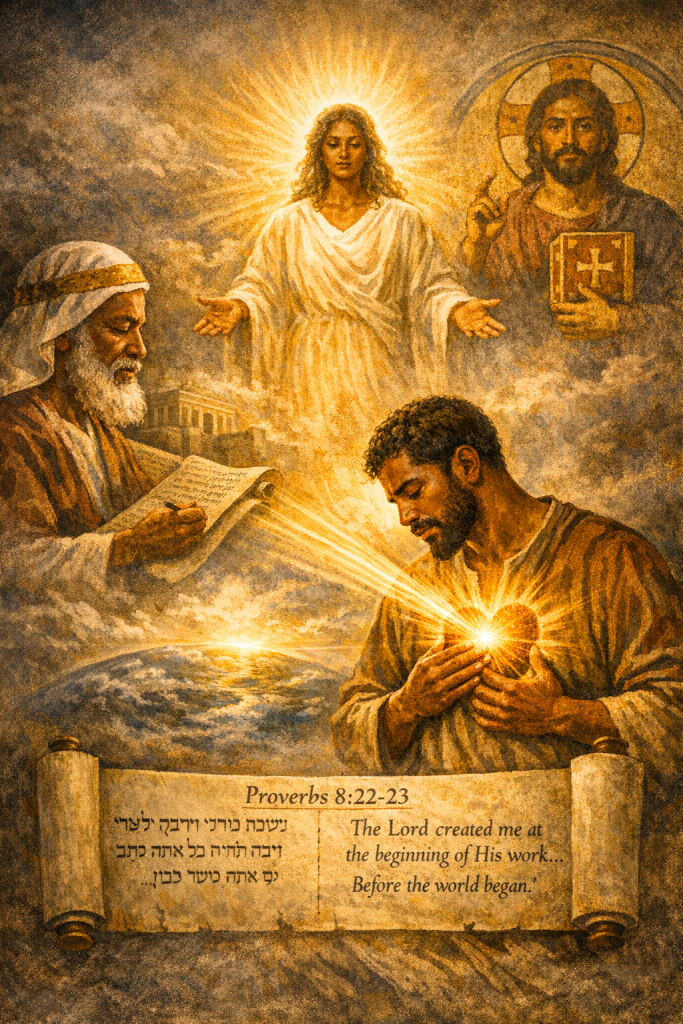
Proverbs 8 is a highly influential text within Second Temple-era Judaism and its first-century mutations. Jews and Christians alike engaged with it, each trying to understand the passage’s contribution to the identity of the creator. Many great Christian thinkers have read this passage as descriptive of the Trinitarian Father-Son relationship. Justin Martyr and Origen were among the first to use Proverbs 8 in this way, a move that would later influence Nicene theology. They read the passage as saying that the Father created with the aid of, or through, Wisdom, later identified with the Son. Below is the relevant portion:
Proverbs 8:22-31 NRSVUE
[22] “The LORD created me at the beginning of his work, the first of his acts of long ago. [23] Ages ago I was set up, at the first, before the beginning of the earth. [24] When there were no depths I was brought forth, when there were no springs abounding with water. [25] Before the mountains had been shaped, before the hills, I was brought forth, [26] when he had not yet made earth and fields or the world’s first bits of soil. [27] When he established the heavens, I was there; when he drew a circle on the face of the deep, [28] when he made firm the skies above, when he established the fountains of the deep, [29] when he assigned to the sea its limit, so that the waters might not transgress his command, when he marked out the foundations of the earth, [30] then I was beside him, like a master worker, and I was daily his delight, playing before him always, [31] playing in his inhabited world and delighting in the human race.
It is important to begin by pointing out that this is a poetic writing. The passage presents Wisdom as God’s first act of creation. This being the case, Wisdom witnessed all of creation happening subsequently. Indeed, the language of verse 30 implies that Wisdom was not a mere spectator but was actively involved in some unstated way as a “master worker.”
This text apparently influenced Philo of Alexandria (30BC – 50 CE), a very important Jewish philosopher. Interacting with the Greek traditions he was trained in, Philo arguably identified the Wisdom of the Jewish tradition with the Logos of Greek deliberations. For Heraclitus, one of the earliest Greek philosophers to think about the nature of the Logos, the Logos appears as an impersonal organizing principle of the cosmos. Philo, however, imbued the Logos with life, calling it “the firstborn of God” (cited in Copleston). He might have derived this idea from Jewish Wisdom traditions, as Proverbs 8 makes a similar claim. He further writes, “the Logos of the living God is the bond of everything, holding all things together and binding all the parts, and prevents them from being dissolved and separated” (cited by Friedlander). So, like Heraclitus, Philo also held that the Logos was the organizing principle of the cosmos.
Justin Martyr and Origen were among the earliest Christians to draw on Proverbs 8 for ideas about the Trinitarian Father-Son relationship. A major problem for these church fathers was that Proverbs 8 seemed to suggest that Wisdom was created. To avoid this problem, some early Christians insisted that the poetic language of the chapter should not be pressed too hard for literalness. Origen read the created language as the eternal generation of the Son.
We should, however, stress that Proverbs 8 nowhere suggests that Wisdom was itself God or even divine. Nevertheless, the chapter contains ideas that were later further developed by Christians. For instance, John writes:
John 1:1-3 ESV
[1] In the beginning was the Word, and the Word was with God, and the Word was God. [2] He was in the beginning with God. [3] All things were made through him, and without him was not any thing made that was made.
While alluding to Proverbs 8 (and Genesis 1), these Johannine verses make a major development of Proverbs 8’s claims. John explicitly says the Logos is God. John also goes further than Proverbs 8, stating that the Logos is the creator, not just a “master worker.”
Similarly, Paul also apparently interacts with ideas of the time:
Colossians 1:15-17 ESV
[15] He is the image of the invisible God, the firstborn of all creation. [16] For by him all things were created, in heaven and on earth, visible and invisible, whether thrones or dominions or rulers or authorities—all things were created through him and for him. [17] And he is before all things, and in him all things hold together.
By describing Jesus as “the firstborn of all creation,” Paul used the exact language Philo used for his Logos. Now, as we have explained elsewhere, this “firstborn” language in Paul does not entail that Jesus was created. Furthermore, Paul seems to engage with ideas found in Philo when he says, “And he is before all things, and in him all things hold together.” Recall that Philo states that “the Logos of the living God is the bond of everything, holding all things together,” as quoted earlier. Also, we already noted the pre-existence idea of Colossians 1:17 earlier in Proverbs 8.
The influence of Proverbs 8 on later Christian thought, canonical or not, cannot be overemphasized.
Works Cited
Copleston, Frederick. A History of Philosophy, Volume 1, Continuum, (2003), pp. 458–462.
Philo, De Profugis, cited in Gerald Friedlander, Hellenism and Christianity, P. Vallentine, 1912, pp. 114–115.