
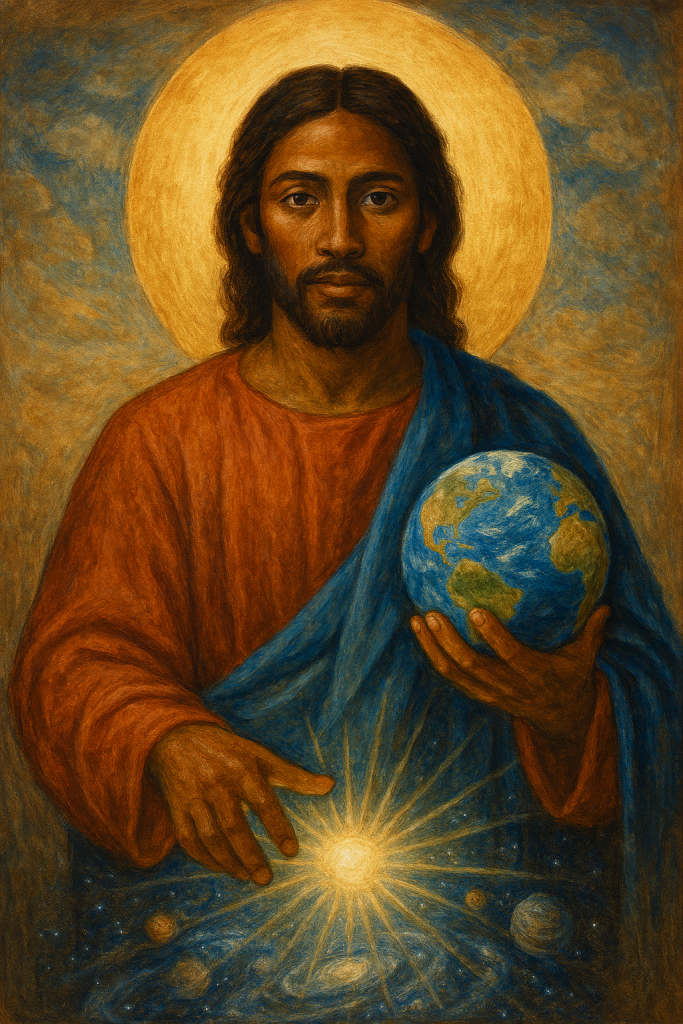
Three New Testament texts by different authors explicitly claim that Jesus is the creator of the cosmos. For some strange reasons I do not fully understand, many in the church have historically been uncomfortable with the claim and have found ways to blunt the force of the assertion:
John 1:1, 3, 14 ESV
[1] In the beginning was the Word, and the Word was with God, and the Word was God.
[3] All things were made through him, and without him was not any thing made that was made.
[14] And the Word became flesh and dwelt among us, and we have seen his glory, glory as of the only Son from the Father, full of grace and truth.
Colossians 1:15-17 ESV
[15] He is the image of the invisible God, the firstborn of all creation. [16] For by him all things were created, in heaven and on earth, visible and invisible, whether thrones or dominions or rulers or authorities—all things were created through him and for him. [17] And he is before all things, and in him all things hold together.
Hebrews 1:1-3 ESV
[1] Long ago, at many times and in many ways, God spoke to our fathers by the prophets, [2] but in these last days he has spoken to us by his Son, whom he appointed the heir of all things, through whom also he created the world. [3] He is the radiance of the glory of God and the exact imprint of his nature, and he upholds the universe by the word of his power. After making purification for sins, he sat down at the right hand of the Majesty on high,
The contexts vary slightly, but the authors are quite explicit in their assertion that Jesus is the agent of creation. John says that all things were made through the Logos, and that without him nothing was created. Paul says to the Colossians, who were under external pressure to kowtow to inferior beings, that all things, visible and invisible, were created by Jesus. The Greek text is unambiguous. Paul employs three different prepositions to claim that Jesus is the sphere, agent, and purpose or goal of creation. The scholarly consensus is that Paul did not write Hebrews. If that is correct, we have another early source saying the universe was created through Jesus; more than that, Jesus upholds the universe. I suspect that part of the difficulty might be the through language. Whatever the author of Hebrews meant by this language, when we read his claim in light of the other two sources, it is unlikely he would deny the agency of Jesus as the creator. We shall return to this point. In this entry, I shall argue that the New Testament claim that Jesus is the creator is perfectly in line with the Hebrew Bible and poses no threat to Trinitarian doctrine.
Church practices have reinforced the idea that God the Father is the creator of the universe, but it is important to recall that Genesis itself does not make this claim. Genesis 1 says Elohim created the world, and Genesis 2 says Yahweh Elohim created the world (Genesis 2:4). In Trinitarian terminology, these divine labels do not uniquely refer to the Father. They present a divine agent creating without differentiating persons within the Godhead. So, the claims of John 1, Colossians 1, and Hebrews 1 are not in opposition to what Genesis says.
Divine Fatherhood
There is another issue worth addressing. As I have written elsewhere, the divine Father language is a unique New Testament reality that does not apply to the Hebrew Bible. Indeed, the Old Testament occasionally describes God as a father, but these uses do not carry the same sense as those in the New Testament. Consider the following instances:
Deuteronomy 32:6 ESV
Do you thus repay the Lord, you foolish and senseless people? Is not he your father, who created you, who made you and established you?
This text applies explicitly to the ancient Israelites. Though we often overlook a detail the Hebrew Bible repeatedly stresses, Yahweh was not the God of the whole world after the calling of Abraham. He was the father of Israel only. Hence, “created” here is not in the same sense as the creation of the cosmos in Genesis but is restricted to the making of a descendant of Abraham. Here is the immediate context of this verse:
Deuteronomy 32:7-9 ESV
[7] Remember the days of old; consider the years of many generations; ask your father, and he will show you, your elders, and they will tell you. [8] When the Most High gave to the nations their inheritance, when he divided mankind, he fixed the borders of the peoples according to the number of the sons of God. [9] But the LORD’s portion is his people, Jacob his allotted heritage.
God “divided mankind” but chose Jacob (that is, Israel) as “his allotted heritage.” This act of choosing is what verse 6 above references. So, no, we may not extrapolate the use of “father” here to either the creation account in Genesis or the New Testament use of a similar language. The language here is covenantal, not ontological. This same use of the Father language is found in Isaiah:
Isaiah 63:16 ESV
For you are our Father, though Abraham does not know us, and Israel does not acknowledge us; you, O LORD, are our Father, our Redeemer from of old is your name.
Isaiah 64:8 ESV
But now, O LORD, you are our Father; we are the clay, and you are our potter; we are all the work of your hand.
These verses refer to the establishmemt of the ancient Israelites. Here is another occurrence of the Father language:
2 Samuel 7:14-15 ESV
[14] I will be to him a father, and he shall be to me a son. When he commits iniquity, I will discipline him with the rod of men, with the stripes of the sons of men, [15] but my steadfast love will not depart from him, as I took it from Saul, whom I put away from before you.
This ought to be straightforward. God is here assuring David that He will be kind to David’s son, Solomon. If Solomon were faithful, God would be to him a father. As explained elsewhere, Solomon was not a faithful son later in his years, and God judged him and his offspring for it. The “Father” language here does not map onto the New Testament’s use.
The Father Language in the New Testament
As argued elsewhere, Christians call God Father because of the Incarnation. Unlike the Old Testament’s uses of the Father language, the New Testament consistently emphasizes that God is the Father of Jesus Christ (e.g., Matthew 3:17, 17:5, John 20:17) and, derivatively, the Father of believers in Jesus. Christians refer to God as Father because Jesus introduced God as Father in the Gospels. This fact explains why we call God “Abba, Father” – a phrase that doubly names God as Father. Jesus introduced believers to a God who was his Father, and his followers used that language thereafter to refer to God (1 Corinthians 8:6, Romans 1:3-4, 2 Corinthians 1:3, Hebrews 1:5, 1 John 4:9, Ephesians 1:3). Hence, the New Testament sense of the divine fatherhood language is distinct: God played the role of a father in the conception of Jesus. That is what the incarnation is about. (See our fuller address of this matter here.)
Jesus as Yahweh
We argued in another blog entry that the New Testament portrays Jesus as Yahweh. (The argument is too lengthy to reproduce here. The reader should consult the entry here.) There are different ways the New Testament portrays Jesus as Yahweh. I will briefly share one major way they go about it: applying Old Testament passages about Yahweh to Jesus. For instance, Isaiah prophesied about the coming of Yahweh:
Isaiah 40:3
A voice cries: “In the wilderness prepare the way of Yahweh; make straight in the desert a highway for our God.
The prophecy offers hope to the people in exile. Isaiah is saying that a clear path should be prepared in the wilderness so that Yahweh may appear and lead the people back to the promised land, just as he did with Joshua’s generation. Interestingly, Mark quotes this passage and applies it to Jesus:
Mark 1:1-3 ESV
[1] The beginning of the gospel of Jesus Christ, the Son of God. [2] As it is written in Isaiah the prophet, “Behold, I send my messenger before your face, who will prepare your way, [3] the voice of one crying in the wilderness: ‘Prepare the way of the Lord, make his paths straight,’”
Mark has understood the text as saying Jesus is “the Lord,” Yahweh, whom Isaiah prophesied about. Jesus, of course, was the one John the Baptizer prepared the way for with his ministry. So, in Mark’s use, John is the one who prepared the way, and Jesus is cast in the role of Yahweh coming through.
In another example, the prophet Joel writes:
Joel 2:32
And it shall come to pass that everyone who calls on the name of Yahweh shall be saved. For in Mount Zion and in Jerusalem there shall be those who escape, as Yahweh has said, and among the survivors shall be those whom Yahweh calls.
Everyone who calls on the name of Yahweh shall be saved. Yet, the Pharisee and Apostle Paul boldly applied this scripture to Jesus:
Romans 10:9, 13 ESV
[9] because, if you confess with your mouth that Jesus is Lord and believe in your heart that God raised him from the dead, you will be saved.
[13] For “everyone who calls on the name of the Lord will be saved.”
The “name of the Lord” here refers to Jesus, as Peter told the highest Jewish legal authority on Scripture:
Acts 4:11-12 ESV
[11] This Jesus is the stone that was rejected by you, the builders, which has become the cornerstone. [12] And there is salvation in no one else, for there is no other name under heaven given among men by which we must be saved.”
So, two foremost Apostles of Jesus agree that only Jesus’ name saves. The implication is that Jesus is the Yahweh spoken of by Joel. Indeed, Paul goes a step further in making the connection explicit. When he writes to the Philippians that Jesus was the recipient of the name that is above every name (Philippians 2:9,10), he was fleshing out this link. In a religious Jewish context, “the name that is above every name” is uncontestably Yahweh. That name is now merged with “Jesus,” so that when someone calls “Jesus,” they are calling Yahweh.
There are several other data points one could point to in this regard. New Testament authors use sophisticated Jewish-style hermeneutics to portray Jesus as Yahweh. For my purposes here, the examples above will have to suffice. Here is the point I am driving at: the fact that Genesis says Yahweh is the creator of the universe does not imply that God the Father is the referent, as popularly assumed. For some early Jewish followers of Jesus, the creator is Jesus! These disciples would have been familiar with texts like the following:
Psalm 102:1, 25 ESV
[1] Hear my prayer, O LORD; let my cry come to you!
[25] Of old you laid the foundation of the earth, and the heavens are the work of your hands.
Yet, they conclude that Jesus is Yahweh, the one who laid the foundation of the earth and created the heavens!
Saying Jesus is the creator does not necessarily mean the Father and the Spirit played no role. Some have suggested that the Father gave the command for creation, and Jesus executed it. The idea here is carving out a space where the Father is the ultimate explanation for creation. This is plausible – very likely, even. John says, “The Father loves the Son and has given all things into his hand” (John 3:35 ESV). Certainly, for John, “all things” include creation itself. Also, the author of Hebrews states that the Father created the world through Jesus (Hebrews 1:1-2). Notice, however, that Jesus would still be the immediate agent of creation and the divine being described in Genesis as the creator. An analogy may help. Suppose I contract with a competent builder to build a house, and he delivers it according to my desires. It would not be wrong for me to say in conversations that I built the house the way I wanted. But, of course, the immediate builder is the contractor. I am only mediately the builder in that I provided instructions for the construction.
Objection #1: Proverbs 8 and Philo of Alexandria
Proverbs 8 is a highly influential text within Second Temple-era Judaism and its first-century mutations. Jews and Christians alike engaged with it, each trying to understand the passage’s contribution to the identity of the creator. Many great Christian thinkers have read this passage as descriptive of the Trinitarian Father-Son relationship. Justin Martyr and Origen were among the first to use Proverbs 8 in this way, a move that would later influence Nicene theology. They read the passage as saying that the Father created with the aid of, or through, Wisdom, later identified with the Son. As I shall show, this is a misreading. Below is the relevant portion:
Proverbs 8:22-31 NRSVUE
[22] “The LORD created me at the beginning of his work, the first of his acts of long ago. [23] Ages ago I was set up, at the first, before the beginning of the earth. [24] When there were no depths I was brought forth, when there were no springs abounding with water. [25] Before the mountains had been shaped, before the hills, I was brought forth, [26] when he had not yet made earth and fields or the world’s first bits of soil. [27] When he established the heavens, I was there; when he drew a circle on the face of the deep, [28] when he made firm the skies above, when he established the fountains of the deep, [29] when he assigned to the sea its limit, so that the waters might not transgress his command, when he marked out the foundations of the earth, [30] then I was beside him, like a master worker, and I was daily his delight, playing before him always, [31] playing in his inhabited world and delighting in the human race.
It is important to begin by pointing out that this is a poetic writing. The passage presents Wisdom as God’s first act of creation. This being the case, Wisdom witnessed all of creation happening subsequently. Indeed, the language of verse 30 implies that Wisdom was not a mere spectator but was actively involved in some unstated way as a “master worker.”
This text apparently influenced Philo of Alexandria (30BC – 50 CE), a very important Jewish philosopher. Interacting with the Greek traditions he was trained in, Philo arguably identified the Wisdom of the Jewish tradition with the Logos of Greek deliberations. For Heraclitus, one of the earliest Greek philosophers to think about the nature of the Logos, the Logos appears as an impersonal organizing principle of the cosmos. Philo, however, imbued the Logos with life, calling it “the firstborn of God” (cited in Copleston). He might have derived this idea from Jewish Wisdom traditions, as Proverbs 8 makes a similar claim. He further writes, “the Logos of the living God is the bond of everything, holding all things together and binding all the parts, and prevents them from being dissolved and separated” (cited by Friedlander). So, like Heraclitus, Philo also held that the Logos was the organizing principle of the cosmos.
Justin Martyr and Origen sought out Proverbs 8 for ideas about the Trinitarian Father-Son relationship. A major problem for these church fathers was that Proverbs 8 seemed to suggest that Wisdom was created. To avoid this problem, some early Christians insisted that the poetic language of the chapter should not be pressed too hard for literalness. Origen read the “created” language as the eternal generation of the Son.
However, we should stress that Proverbs 8 nowhere suggests that Wisdom was itself God or even divine. These early Christian thinkers were a bit too creative with the chapter’s claims. Nevertheless, the chapter contains ideas that were later further developed by some New Testament authors. For instance, John writes:
John 1:1-3 ESV
[1] In the beginning was the Word, and the Word was with God, and the Word was God. [2] He was in the beginning with God. [3] All things were made through him, and without him was not any thing made that was made.
While alluding to Proverbs 8 (and Genesis 1), these Johannine verses make a major development of Proverbs 8’s claims. John explicitly says the Logos is God. John also goes further than Proverbs 8, stating that the Logos is the creator, not just a “master worker.” Similarly, Paul also apparently interacts with ideas of the time:
Colossians 1:15-17 ESV
[15] He is the image of the invisible God, the firstborn of all creation. [16] For by him all things were created, in heaven and on earth, visible and invisible, whether thrones or dominions or rulers or authorities—all things were created through him and for him. [17] And he is before all things, and in him all things hold together.
By describing Jesus as “the firstborn of all creation,” Paul used the exact language Philo used for his Logos. Now, as we have explained elsewhere, this “firstborn” language in Paul does not entail that Jesus was created. Furthermore, Paul seems to engage with ideas found in Philo when he says, “And he is before all things, and in him all things hold together.” Recall that Philo states that “the Logos of the living God is the bond of everything, holding all things together,” as quoted earlier. Also, we already noted the pre-existence idea of Colossians 1:17 earlier in Proverbs 8.
So, we see that New Testament authors do not read Proverbs 8 in the way that some church fathers did. Their interaction with Proverbs 8, via the wisdom tradition, goes further. Unlike Proverbs 8, the authors claimed that Jesus is the creator.
Objection #2: What about 2 Corinthians 4:6?
The reader may assume that 2 Corinthians 4:6 undermines the claim that Jesus is the immediate creator because Paul appears to attribute the Genesis 1 light‑command to “God”:
2 Corinthians 4:6 ESV
For God, who said, “Let light shine out of darkness,” has shone in our hearts to give the light of the knowledge of the glory of God in the face of Jesus Christ.
Traditionally, commentators have taken “God” in this verse to refer to the Father, and there are good reasons for doing so. Typically, when Paul says “God” in proximity to terms referring to Jesus (e.g., Jesus, Christ, Jesus Christ, the Son, etc) as a distinct person, “God” refers to the Father. For instance, “I give thanks to my God always for you because of the grace of God that was given you in Christ Jesus” (1 Corinthians 1:4). If we apply the same reasoning to the text, “God” will refer to the Father. This may imply that the Father is the divine person in Genesis who says, “Let there be light,” and hence the immediate creator. The same divine person is now shining “the light of the knowledge of the glory of God” in human hearts by the gospel that Paul preached to the Corinthians. However, in light of the christological saturation of the passage, I shall demonstrate that Paul’s language in 4:6, at minimum, allows “God” to include Jesus and that this verse does not invalidate the conclusion that Jesus is the immediate creator of the cosmos. Below is the text in its immediate context:
2 Corinthians 4:4-6 ESV
In their case the god of this world has blinded the minds of the unbelievers, to keep them from seeing the light of the gospel of the glory of Christ, who is the image of God. [5] For what we proclaim is not ourselves, but Jesus Christ as Lord, with ourselves as your servants for Jesus’ sake. [6] For God, who said, “Let light shine out of darkness,” has shone in our hearts to give the light of the knowledge of the glory of God in the face of Jesus Christ.
Unbelievers are blinded as though in a dark room because they do not have “the light of the gospel of the glory of Christ.” This “glory of Christ” is connected to “the glory of God.” These are not competing divine glories. On the contrary, the “glory of God” is revealed in Christ. Just as Moses radiated the glory of the old covenant (2 Corinthians 3:7), the glory of God also shines in “the face of Christ Jesus.”
The first thing to note is that Paul does not seem concerned about differentiating among the divine persons in these verses. While it is true that when Paul mentions Christ in proximity to God, he usually refers to the Father, this is merely a pattern not necessitated by grammar rules or logic. Paul can and often clearly adds “Father” to labels intended to pick out the Father. For example:
2 Corinthians 1:2 ESV
Grace to you and peace from God our Father and the Lord Jesus Christ.
But he does not use the paternal language in 4:4-6. Besides, Paul elsewhere also uses “God” in ways that include Christ within the divine identity:
Romans 9:5 ESV
To them belong the patriarchs, and from their race, according to the flesh, is the Christ, who is God over all, blessed forever. Amen.
Philippians 2:5-6 ESV
[5] Have this mind among yourselves, which is yours in Christ Jesus, [6] who, though he was in the form of God, did not count equality with God a thing to be grasped,
These verses show that Paul can include Christ in his “God” language. So if Paul is not concerned with differentiating divine persons in 2 Corinthians 4:6, there is no reason to press too hard for his intended referent of “God.”
More importantly, notice that the focus of 2 Corinthians 4:4-6 is Christ. Hence, Jesus is “the image of God,” the one proclaimed as Lord, and the one for whom Paul and his colleagues became servants of the Corinthians. So, if Paul can sometimes include Jesus in his “God” language, it is not unreasonable to think the referent of “God” in a christologically rich context like 4:4-6 may be Jesus. Moreover, commentators generally believe that Paul alludes to Genesis 1:3 in verse 6, but notice that the light that shone in “our hearts” is God (“God…shone in our hearts”). But elsewhere, Paul says Jesus resides in believers’ hearts:
Ephesians 3:14-17 ESV
[14] For this reason I bow my knees before the Father, [15] from whom every family in heaven and on earth is named, [16] that according to the riches of his glory he may grant you to be strengthened with power through his Spirit in your inner being, [17] so that Christ may dwell in your hearts through faith—that you, being rooted and grounded in love,
Interestingly, Paul here clearly marks out “the Father,” but it is Christ who is said to dwell in the believer’s heart. Paul also says to the Galatians in 4:19 that it is Christ who is being formed in them. It gets even more fluid:
Romans 8:9-10 ESV
[9] You, however, are not in the flesh but in the Spirit, if in fact the Spirit of God dwells in you. Anyone who does not have the Spirit of Christ does not belong to him. [10] But if Christ is in you, although the body is dead because of sin, the Spirit is life because of righteousness.
Here, Paul uses “Spirit of God,” “Spirit of Christ,” “Spirit,” and “Christ in you” interchangeably. So, who exactly resides in a believer’s heart? For Paul, the one God of Israel does! Paul takes much liberty in describing this reality, as the texts show. So, the “God” language of 2 Corinthians 4:6 is fluid and includes Jesus.
We have thus seen that the standard reading that “God” in 4:6 refers to the Father is itself influenced by the pervasive assumption that the Father is the creator described in Genesis. Once we question that assumption, the popular reading of 2 Corinthians 4:6 loses its force. Interestingly, Paul also claims that Christ is the creator in the Corinthian correspondence:
1 Corinthians 8:5-6 ESV
[5] For although there may be so-called gods in heaven or on earth—as indeed there are many “gods” and many “lords”— [6] yet for us there is one God, the Father, from whom are all things and for whom we exist, and one Lord, Jesus Christ, through whom are all things and through whom we exist.
Once again, Paul clearly distinguishes among the divine persons when necessary. Here, Paul says “all things” are from the Father and through Jesus, using language similar to that in his letter to the Colossians. So, we may not use 2 Corinthians 4:6 to invalidate an idea Paul posits within the Corinthian correspondence and elsewhere:
Colossians 1:16 NKJV
For by Him all things were created that are in heaven and that are on earth, visible and invisible, whether thrones or dominions or principalities or powers. All things were created through Him and for Him.
So, the “all things” of 1 Corinthians 8:6 is all of creation.
An interesting connection with the gospel of John is worth mentioning briefly:
John 1:1-5 ESV
[1] In the beginning was the Word, and the Word was with God, and the Word was God. [2] He was in the beginning with God. [3] All things were made through him, and without him was not any thing made that was made. [4] In him was life, and the life was the light of men. [5] The light shines in the darkness, and the darkness has not overcome it.
First, the Father committed “all things” to Jesus (John 3:35). Then, “all things” were made by and through Jesus. That is, Jesus brought “all things” into being – “and without him was not any thing made that was made.” Second, John says in Jesus was life and the life was the light of men, shining in darkness. This language is reminiscent of 2 Corinthians 4:6,
2 Corinthians 4:6 ESV
For God, who said, “Let light shine out of darkness,” has shone in our hearts to give the light of the knowledge of the glory of God in the face of Jesus Christ.
Paul says “God…shone in our hearts,” while John says Christ is the source of light, not merely its reflector. The Johannine text enables us to see Paul’s point that “the light” is mediated by Jesus and christologically defined (“in the face of Jesus Christ”).
Thus, nothing in 2 Corinthians 4:6 requires us to exclude Christ from the identity of the “God” who said, “Let light shine out of darkness.” If anything, Paul’s christological pattern encourages us to see Christ as the very one who spoke that primordial light into being and who now shines that same creative light into human hearts. And, given that, this verse does not threaten my conclusion that Jesus is the immediate creator described in Genesis 1.
Creation, Jesus, and the New Creation
In her book, Being God’s Image, Carmen Imes argues that Jesus being the image of God is not a description of his divinity but humanity (138). The phrase “image of God” properly and uniquely denominates humans. Only humans were said to be made as the images of God. This being the case, Imes invites us to see many of the recorded acts of Jesus as not the unique acts of God but what are true about the new humanity. For instance, when the resurrected Jesus passed through a wall, as in The Matrix, or levitated, like Dr. Strange, the point is not to see these events as unique to Jesus. On the contrary, these acts, and many others, foretell what is true about the new species of humanity Jesus has made possible. Perhaps this was what Paul had in mind when he said that believers will meet Jesus in the sky to welcome him on his return to the earth (1 Thessalonians 4:13-18). Humans will have to have the ability to levitate for this to happen.
In his letter to the Philippians, Paul seems to have assumed the need to understand Jesus as a true human:
Philippians 2:5-7 NRSVUE
[5] Let the same mind be in you that was in Christ Jesus, [6] who, though he existed in the form of God, did not regard equality with God as something to be grasped, [7] but emptied himself, taking the form of a slave, assuming human likeness. And being found in appearance as a human
Because he was a human, the incarnate Jesus did not regard his “Godness” as something to be used to his advantage. He knew he was God – and to be sure, there were instances in the New Testament when people discerned the God underneath his olive-brown skin. But he chose to model what it means to be a new human through the incarnation. By taking up flesh, Jesus primarily functioned as the ideal image of God, a human being.
It is no accident that Jesus is at the center of the New Creation. He is completing what he started. The whole divine program was leading to the new creation. Hence, Jesus declares, “I am making all things new” (Revelation 1:5). Also, Jesus is the standard of the new humanity. Paul writes:
Romans 8:29 ESV
For those whom he foreknew he also predestined to be conformed to the image of his Son, in order that he might be the firstborn among many brothers.
The human Jesus is now the standard that humanity must conform to in the new creation. He is the new reality believers are encouraged, using a clothing metaphor, to put on (Ephesians 4:24, Colossians 3:10, Romans 13:14). Also, since Jesus now has a resurrected body, faithful believers will also get incorruptible bodies (1 Corinthians 15:52, 53). Indeed, Jesus declares that he is the resurrection and life (John 11:25). His resurrection inaugurated the new creation.
There are many other descriptions of Jesus marking him as the fulcrum of the new creation. Hence, Jesus is the new, better, second, and last Adam (1 Corinthians 15:45). Where the first Adam failed by eating what was forbidden (Genesis 3:6), Jesus refused to turn stone to bread to meet his dire needs (Matthew 4:3-4). As a result, whereas the first Adam was barred from subsequently accessing the tree of life, the last Adam has restored access to humanity (Revelation 22:14). In other words, Jesus restores creation order (Colossians 1:20, Ephesians 1:10), and his (and the Father’s) throne is the center of the renewed order (Revelation 22:3-4). Indeed, he is the source of the new life (John 3:16-18, 11:25-26). These ideas inform such bold assertions as the following:
Hebrews 1:8 ESV
But of the Son he says, “Your throne, O God, is forever and ever, the scepter of uprightness is the scepter of your kingdom.
The “Son” is said to be God with an eternal throne, ruling forever.
Conceivably, someone might argue that the New Testament is wrong in its interpretation of the Hebrew Bible. It is, however, of no use to pretend that the New Testament authors did not assert the claims they so unapologetically make. The authors make it very clear that Jesus is the creator. I repeat: saying that Jesus is the creator should not be understood as implying that the Father and the Spirit were unaware or played no role. There is perfect agreement and alignment in the Godhead. The Revelation text referenced above says:
Revelation 22:3 ESV
No longer will there be anything accursed, but the throne of God and of the Lamb will be in it, and his servants will worship him.
Notice that “throne” is singular. Two persons are sharing one throne, and Revelation 3:21 elucidates the point. Obviously, that only works if they are in full agreement. This is yet another way New Testament authors portray Jesus as Yahweh. Sharing the throne with the Father implies co-reign and co-authority. Here is one more example from Revelation:
Revelation 22:5 ESV
And night will be no more. They will need no light of lamp or sun, for the Lord God will be their light, and they will reign forever and ever.
Revelation 21:23 ESV
And the city has no need of sun or moon to shine on it, for the glory of God gives it light, and its lamp is the Lamb.
So, who exactly lights up the New Creation – Jesus or the Father? As far as John is concerned, it seems like a distinction with no difference. The Father or Jesus, as Maui says to Moana, amounts to the “same difference.”
Works Cited
Copleston, Frederick. A History of Philosophy, Volume 1, Continuum, (2003), pp. 458–462.
Imes, Carmen Joy. Being God’s Image: Why Creation Still Matters. InterVarsity Press, 2024.
Philo, De Profugis, cited in Gerald Friedlander, Hellenism and Christianity, P. Vallentine, 1912, pp. 114–115.
3 Comments